Is Trenchless Repair Worth It? Pros, Cons & Lifespan

Table of Contents
- Trenchless Sewer Repair Pros and Cons
- How Long Does Trenchless Sewer Repair Last?
- Signs You Need Sewer Repair
- Is Trenchless Repair Worth It?
- Frequently Asked Questions
Last Updated: September 13, 2026
Trenchless Sewer Repair Pros and Cons
Trenchless sewer repair restores underground pipes with a resin-impregnated liner or by bursting the old pipe in place, using small access points instead of a long open trench. For most homeowners the pros outweigh the cons: minimal digging, faster timelines, and intact landscaping, at the tradeoff of a higher upfront quote and a method that only works when the pipe still has enough structural integrity to line.
Pros
- Minimal digging protects driveways, patios, and mature trees
- Faster timelines than a traditional dig
- A jointless new pipe inside the old one
- Works on clay, cast iron, and PVC laterals
Cons
- Higher upfront cost than open excavation in simple, shallow runs
- Not viable for fully collapsed pipe or severe offsets
- Requires accurate camera inspection first
| Factor | Trenchless Repair | Traditional Dig |
|---|---|---|
| Excavation | Small access points | Full-length trench |
| Landscaping | Preserved | Removed and restored |
| Timeline | Faster | Longer |
| Pipe result | Jointless liner | New pipe in trench |
| Best for | Cracks, root intrusion, aging pipe | Collapse, severe offset |
The single question that decides trenchless versus traditional is not cost. It is whether the existing pipe is still round and continuous enough to accept a liner. Get that answer from a camera inspection before you sign anything.
How Long Does Trenchless Sewer Repair Last?
A properly installed cured-in-place pipe (CIPP) liner is designed to last decades, with many manufacturers rating their liners for 50 years or more (nassco.org). Lifespan depends on the resin, installation quality, and what you put down the drain.
- Resin and liner quality: epoxy systems cure harder and resist root intrusion better
- Surface preparation: the pipe must be cleaned and hydro-jetted before lining, or the liner will not bond
- Installation accuracy: a liner that does not fully expand against the host pipe creates gaps where roots re-enter
- What goes down the drain: grease, wipes, and heavy solids shorten any sewer line’s life
A lined pipe does not need repeat snaking, but annual or biennial camera checks catch problems while they are still small.
The most common cause of a failed liner is skipping the pre-lining cleaning step. If a contractor quotes a lining job without a hydro-jetting or mechanical cleaning stage, walk away. The liner will delaminate, and you will pay twice.
Signs You Need Sewer Repair
The clearest signs you need sewer repair are repeated backups in more than one drain, sewage odors indoors or in the yard, slow drains throughout the house, and unexplained wet or sunken patches in the lawn (the CDC). Any one warrants a video camera inspection before you pay for snaking again.
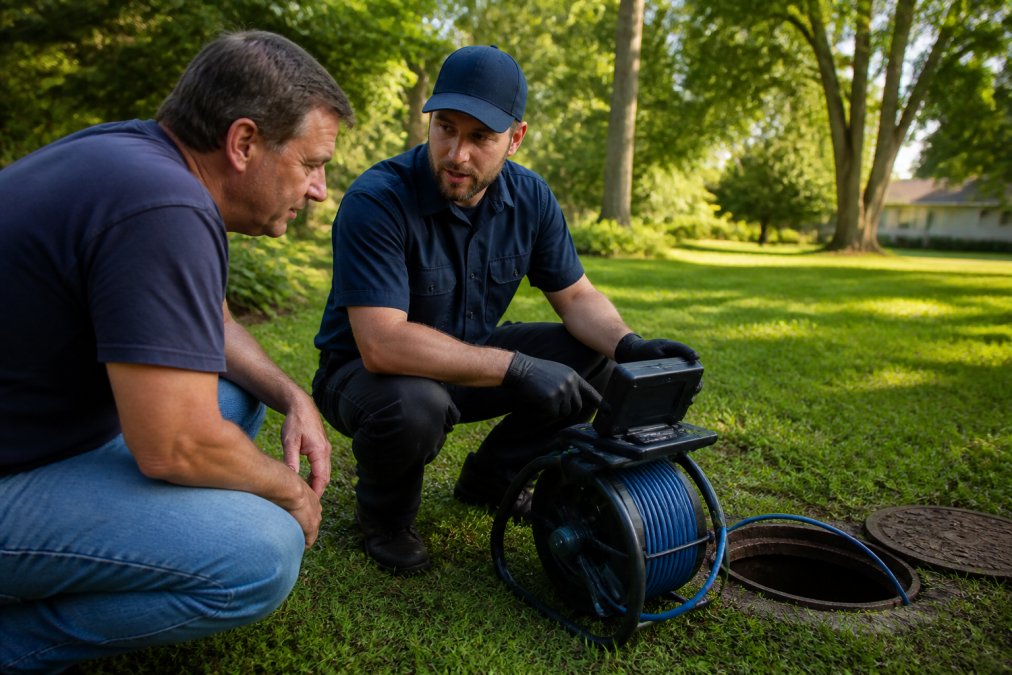
Root intrusion is the most common cause of a slow, recurring blockage in an older sewer lateral: roots enter through joint gaps and hairline cracks, then grow into a mat that catches everything (the EPA). Snaking cuts them back, but they grow again, which is why a homeowner who has paid for the same drain clearing three times is usually a candidate for lining.
Pipe collapse looks different. If the camera shows a crushed or offset section, or the ground above the line has settled, the pipe may not accept a liner at all, and a traditional dig may be the honest answer.
Is Trenchless Repair Worth It?
Trenchless repair is worth it when the pipe is a good candidate and the alternative is tearing up a driveway, patio, or mature landscaping. It is not worth it when the run is short, shallow, and already collapsed, where open excavation is simpler and cheaper.
Pricing depends on pipe diameter, run length, depth, access points, and how much cleaning the line needs before lining. All Sewer and Plumbing Services, LLC provides free estimates so you get a real number for your specific line.
The cost-benefit analysis usually tips toward trenchless: restoration costs disappear, downtime shrinks, and the result is a jointless pipe with no root entry points. When it is not worth it: a fully collapsed line, a severe offset, or a pipe that has lost its shape, where a liner has nothing to bond to.
Ask for the camera footage, not just the recommendation. A contractor who shows you the inside of your own pipe and explains what they see is a contractor who will not surprise you with hidden costs mid-job. Get the inspection on record before work starts.
A failing sewer line is one of the few home repairs where waiting costs more than acting. All Sewer and Plumbing Services, LLC has specialized in trenchless sewer repair and replacement since 2009, using CIPP epoxy pipe lining and pipe bursting to restore lines with minimal digging and free estimates. If you are weighing trenchless repair against a traditional dig, schedule now for a camera inspection and a written estimate.
Frequently Asked Questions
What are the disadvantages of trenchless pipe replacement?
Trenchless repair cannot fix severely collapsed pipes or lines with major offsets. The pipe must still have enough structural integrity for a liner or bursting head to pass through. Access points are also required, so some digging at the ends may be needed. If the existing pipe is too damaged, full excavation may be the only option. A video camera inspection confirms whether trenchless is viable before any work begins.
Will homeowners insurance cover the cost of sewer line replacement?
Standard homeowners insurance typically excludes sewer line replacement because it is considered a maintenance issue. Some policies offer an optional sewer backup endorsement that covers water damage inside the home, but not the pipe itself. Coverage depends on the cause: sudden damage from a covered peril may qualify, while gradual deterioration from root intrusion or age usually does not. Review your policy and ask your insurer directly before scheduling work.
How does CIPP epoxy lining compare to pipe bursting?
CIPP lining creates a new pipe inside the existing one using a resin-impregnated liner, which slightly reduces the pipe diameter but preserves the current path. Pipe bursting pulls a new pipe through while breaking the old one outward, maintaining or increasing diameter and suiting badly damaged lines. Lining works well for cracks and root intrusion; bursting handles collapsed or undersized pipes. A camera inspection determines which method fits your line.
FREE Estimates
How can we help you?

our services


contact our team today
Contact a service professional at All Sewer and Plumbing Services LLC today. We are here to answer all your questions.
OPEN 24 hours 7 days a week