Spot Repair Versus Pipe Lining: Which Works?
A sewer problem rarely stays small for long. One recurring backup, a wet area in the yard, or a camera inspection showing root intrusion can force a costly decision quickly. When considering spot repair versus pipe lining, the right answer depends on the condition of the entire line, not just the location where the first symptom appeared.
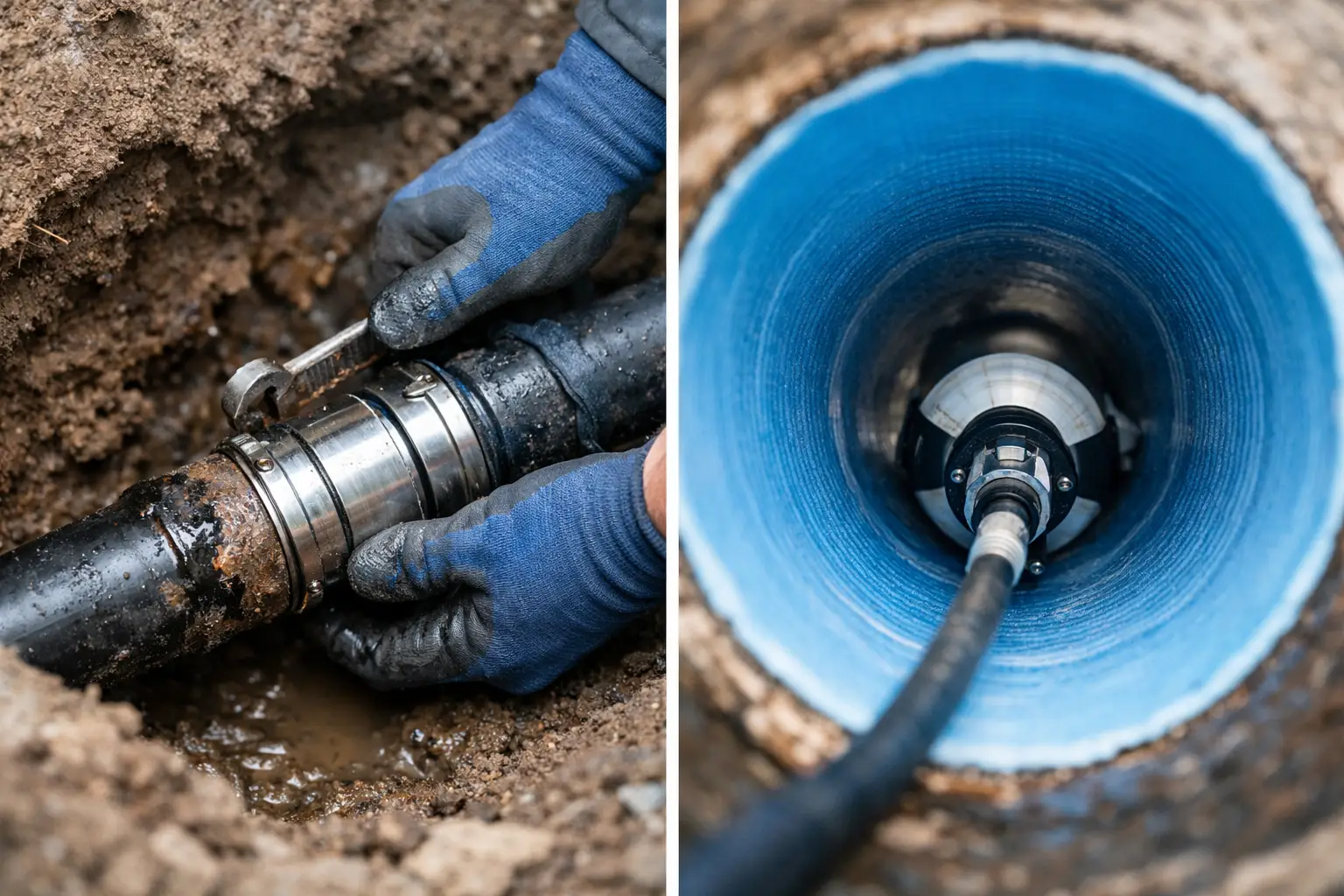
Both methods can avoid the disruption of replacing an entire sewer line through open excavation. But they solve different problems. A spot repair addresses a limited failure at one accessible section of pipe. CIPP epoxy pipe lining rehabilitates a longer section from the inside, creating a new, jointless pipe within the existing host pipe. Knowing the difference helps homeowners, facility managers, and property owners choose a repair that will hold up instead of paying for repeated work.
Spot Repair Versus Pipe Lining: The Core Difference
A spot repair is a targeted repair made at a specific damaged area. The contractor identifies the problem, excavates only where necessary, removes or repairs the failed pipe section, and reconnects the line. This approach is often appropriate when damage is isolated, such as a single broken joint, a localized pipe collapse, or a section crushed by recent construction activity.
Pipe lining is a trenchless rehabilitation method used when a pipe is structurally intact enough to serve as a host but has cracks, separated joints, root intrusion, corrosion, or multiple leaks. After cleaning and inspecting the line, a resin-saturated liner is installed through an access point and cured in place. The result is a continuous new pipe inside the old one, typically without digging up the full route of the sewer line.
The decision is not simply about choosing the cheaper option on the day of service. It is about determining whether the rest of the pipe has enough remaining life to justify a localized repair or whether the line needs broader rehabilitation.
When a Spot Repair Is the Better Option
Spot repair makes sense when video inspection confirms that the failure is truly limited. For example, a sewer line may have one offset joint caused by settlement while the remaining pipe is in sound condition. Repairing that one location can restore flow and prevent further soil intrusion without the cost of lining or replacing a larger section.
It can also be the practical choice when the damaged section has collapsed completely. A liner needs a passable pipe pathway. If the pipe is flattened, severely crushed, or missing a section, excavation may be needed to restore the pipe’s shape before any trenchless work can proceed.
A targeted repair is often useful when the damaged point is easy to access and surface restoration will be limited. A short excavation in an open side yard is a very different project from digging through a mature landscape, driveway, sidewalk, parking lot, or finished interior floor.
That said, a spot repair should not be treated as a default solution simply because it addresses the immediate leak or blockage. If the camera shows root intrusion at several joints, widespread cracking, orangeburg deterioration, or corrosion throughout the line, repairing one point may only move the next failure down the calendar.
Advantages of Spot Repair
The primary benefit is precision. It addresses a known defect directly and can be cost-effective when the rest of the line is verified to be in good condition. It is also the necessary solution for certain severe failures that cannot be lined.
The trade-off is excavation. Even a small dig can involve locating utilities, removing hardscape, working around irrigation, and restoring the affected area afterward. For commercial properties, that can mean restricted access, safety controls, and operational planning. The repair itself may be localized, but the impact of reaching the pipe is not always small.
When Pipe Lining Is the Better Long-Term Repair
Pipe lining is designed for sewer lines with recurring, distributed damage. It is particularly effective for older clay, cast iron, and other aging pipe materials that have developed cracks, leaking joints, root entry points, or internal corrosion over time.
Instead of opening the ground at every damaged joint, pipe lining treats the affected run as one system. The cured liner seals cracks and joints, blocks root intrusion, and forms a smooth internal surface that improves flow. This is often the best option when the line runs beneath landscaping, concrete, foundations, streets, parking areas, or occupied facilities where excavation would be expensive and disruptive.
For a homeowner, that may mean preserving a driveway and established yard. For a restaurant, hotel, hospital, school, or municipal facility, it can mean avoiding a prolonged excavation that affects customers, patients, students, traffic, or daily operations.
Pipe lining is not a cosmetic patch. When correctly specified and installed, CIPP lining is a structural rehabilitation method. The existing pipe becomes the host for a new cured pipe that is engineered to carry wastewater for decades.
Advantages of Pipe Lining
The strongest advantage is reduced disruption. Access is usually gained through existing cleanouts, small access points, or limited excavation at the line’s ends. There is no need to trench the entire pipe route, which can significantly reduce restoration work and labor.
Lining also addresses multiple weak points in a single installation. If a 60-foot sewer lateral has roots entering at six joints and visible cracking along much of its length, lining the complete affected section is generally more dependable than excavating and repairing one joint at a time.
There are limits. The pipe must first be thoroughly cleaned, and the line needs sufficient diameter and continuity for the liner to be installed. Heavy offsets, major bellies, complete collapses, and certain connection configurations may require spot excavation, pipe bursting, or another replacement method. A qualified video inspection determines whether lining is technically appropriate before work begins.
Why Video Inspection Should Drive the Decision
No responsible recommendation should be based only on a slow drain or a general assumption about the pipe’s age. Sewer camera inspection provides the evidence needed to compare repair options. It shows the pipe material, the location and type of damage, root activity, joint condition, sagging, blockages, and whether the line has enough structural integrity for lining.
The most useful inspection is not just a quick look at the first obstruction. The full line should be cleaned as needed and evaluated from the building connection to the municipal connection or septic connection. A single root mass can hide more extensive joint separation farther downstream.
For larger properties, inspection records also support better capital planning. A facilities leader may decide that a short-term spot repair is necessary to restore service now, while scheduling pipe lining or replacement for a broader section during a planned maintenance window. That is a sound operational decision when it is based on clear condition data.
Cost Is More Than the Repair Invoice
A spot repair may have a lower initial price when the damage is confined to one area. However, the full cost should include excavation, utility locating, surface removal, restoration, and the risk of future repairs on the remaining old pipe. A repair beneath a landscaped yard is one situation. The same repair beneath decorative concrete, a busy parking lot, or a building slab is another.
Pipe lining can cost more than a simple isolated repair, but it often reduces total project impact by avoiding extensive digging and restoration. It may also deliver better value when several defects exist in the same run. The relevant question is not, “Which method costs less?” It is, “Which method corrects the actual condition of this sewer line with the fewest future disruptions?”
Property use also matters. A homeowner may be able to tolerate a short excavation in a side yard. A medical facility, restaurant, apartment complex, or school may place a higher value on maintaining access and keeping operations moving. In those cases, trenchless pipe lining can be the more economical decision even when its direct installation cost is higher.
Situations That May Require a Different Method
Some sewer lines are not good candidates for either a simple spot repair or lining alone. A fully collapsed line, severe grade problems, extensive pipe deformation, or a pipe that must be upsized may require trenchless pipe bursting or conventional replacement. Pipe bursting replaces the existing pipe by pulling a new pipe through the old route while breaking apart the failed pipe.
This is why a contractor should explain the condition found, the available methods, and the reason behind the recommendation. A one-size-fits-all answer does not protect the property or the budget. The best repair method is the one that matches the pipe’s condition, location, access constraints, and expected service life.
For Denver and Colorado property owners, All Sewer and Plumbing Services, LLC uses diagnostic inspection and trenchless expertise to identify whether targeted excavation, CIPP pipe lining, or replacement is the most dependable path forward. The goal is to restore the sewer line with as little disruption to the property as the conditions allow.
A sewer repair decision becomes much easier when it starts with a clear camera inspection and an honest assessment of the entire line. Repair the one bad section when it is genuinely the only bad section. When damage is spread through the pipe, choose the solution that stops the cycle of backups, excavation, and repeat repairs.
FREE Estimates
How can we help you?

our services


contact our team today
Contact a service professional at All Sewer and Plumbing Services LLC today. We are here to answer all your questions.
OPEN 24 hours 7 days a week