Best Trenchless Sewer Repair in Denver: 2026 Guide
Table of Contents
- What Is Trenchless Sewer Repair and How Does It Work?
- Signs You Need Trenchless Sewer Repair
- Trenchless Sewer Repair vs Traditional Excavation
- Trenchless Sewer Repair Cost: What Affects Your Quote
- How Long Does Trenchless Sewer Repair Take?
- Local Permit Requirements and Code Compliance
- Insurance, Warranties, and Post-Repair Maintenance
- Why All Sewer and Plumbing Services, LLC Stands Out
- Frequently Asked Questions
Last Updated: August 22, 2026
Most homeowners don’t think about their sewer line until something goes wrong. Then suddenly they’re staring at a sewage backup, a soggy yard, or a repair estimate that makes their stomach drop. At All Sewer and Plumbing Services, LLC, we’ve worked on hundreds of sewer lines across the Denver metro area since 2009, and the single question we hear most is: “Do I really have to dig up my whole yard?” The answer, in most cases, is no. Trenchless sewer repair is a no-dig method that restores damaged pipes from the inside, preserving your landscaping and cutting repair time dramatically.
What Is Trenchless Sewer Repair and How Does It Work?
Trenchless sewer repair restores damaged or deteriorated sewer lines without full-length excavation. Technicians access the pipe through one or two small entry points and repair or replace the line from within using two primary methods: CIPP pipe lining and pipe bursting. A licensed plumber performs a video camera inspection first to determine which method fits your situation.
CIPP (Cured-In-Place Pipe) Lining
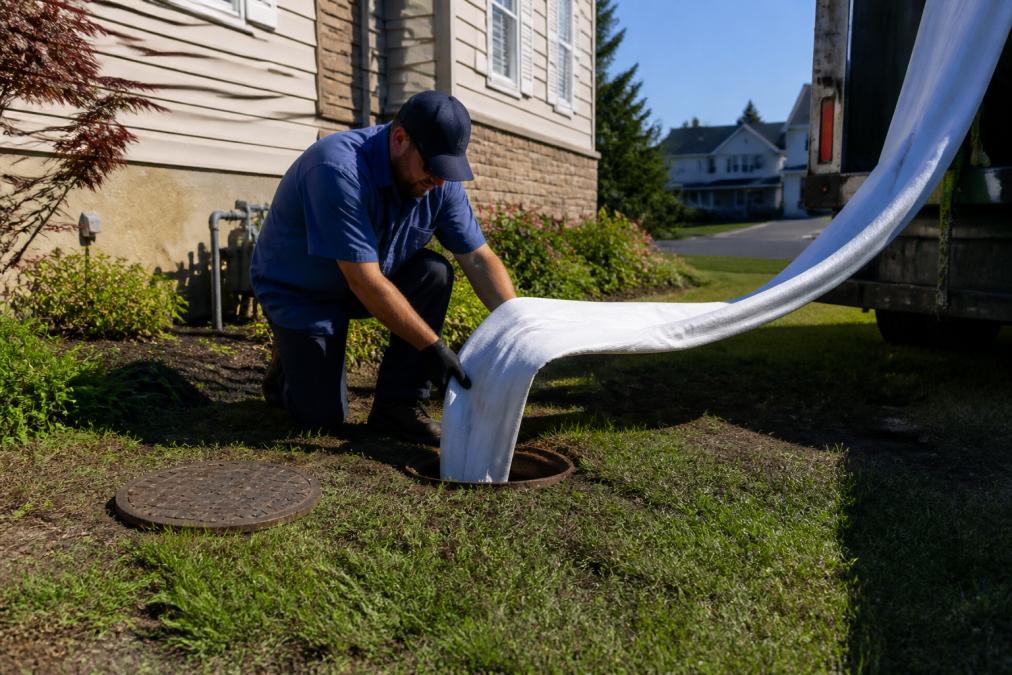
CIPP is a trenchless rehabilitation method where a flexible liner saturated with epoxy resin is inserted into the damaged pipe, inflated against the pipe walls, and cured in place to form a hard, seamless new pipe within the old one.
Technicians clean the existing pipe with hydro-jetting to remove debris, grease, and root intrusion. Then they insert a felt or fiberglass liner coated in epoxy resin, inflate it using air or water pressure, and cure it until it hardens into a structural pipe-within-a-pipe. All Sewer and Plumbing Services, LLC uses Perma-Liner products for CIPP work. CIPP is ideal for pipes with cracks, corrosion, root intrusion, or moderate joint failures, as long as the host pipe has enough structural integrity to hold the liner in place.
Pipe Bursting
Pipe bursting is a trenchless replacement method where a bursting head is pulled through the existing pipe, fracturing it outward into the surrounding soil while simultaneously pulling a new HDPE (high-density polyethylene) pipe into place behind it.
Unlike CIPP, pipe bursting replaces the pipe entirely rather than lining it. This makes it the preferred option when the existing sewer lateral is severely deteriorated, has collapsed sections, or when you want to upsize the pipe diameter. The process requires only small entry and exit pits, keeping landscape damage minimal compared to traditional excavation.
Signs You Need Trenchless Sewer Repair
Catching sewer line failure early saves significant money and prevents secondary damage to your foundation and landscaping.
Watch for these indicators:
- Recurring drain clogs that return within weeks of snaking, suggesting root intrusion or structural damage
- Multiple slow drains throughout the home simultaneously, pointing to a main sewer line issue
- Sewage odors inside the home or in the yard, indicating a crack or breach
- Wet, unusually green, or sunken patches of grass over the sewer line path
- Backflow or sewage gurgling up from floor drains, especially during heavy water use
- Foundation cracks or sinkholes near the sewer line route
- Rodent activity increasing, as rats can enter through cracked sewer pipes
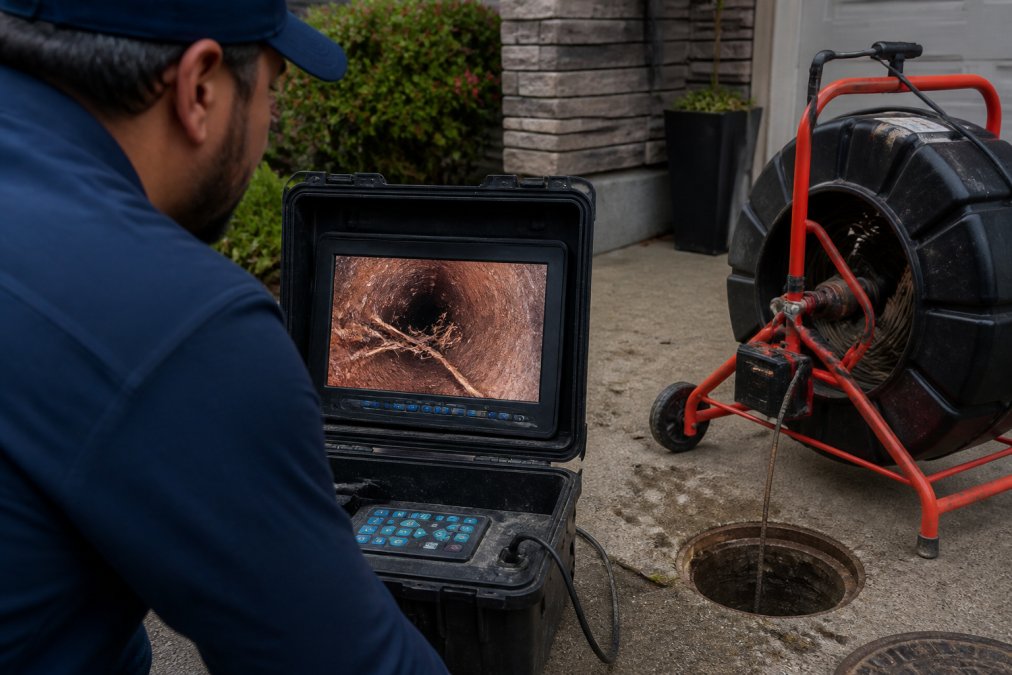
The most reliable diagnostic tool is a CCTV sewer camera inspection. A technician inserts a camera into the line and views the interior in real time, identifying root intrusion, cracks, offset joints, or collapse.
Trenchless Sewer Repair vs Traditional Excavation
Traditional sewer line replacement involves excavating a trench along the full length of the damaged pipe from the home’s foundation to the city sewer main. Trenchless methods access the same pipe through one or two small pits.
For most residential and commercial properties, trenchless sewer repair delivers a faster, less disruptive outcome than traditional excavation. The tradeoff is that trenchless methods require the existing pipe to be accessible and, in the case of CIPP, structurally sound enough to serve as a host.
Pros and Cons of Each Method
|
Factor |
Trenchless Method |
Traditional Excavation |
|---|---|---|
|
Landscape disruption |
Minimal (1-2 small access pits) |
Significant (full trench dug) |
|
Project duration |
Typically 1-2 days |
Often 3-5 days or more |
|
Concrete/pavement removal |
Rarely required |
Frequently required |
|
Pipe material compatibility |
Clay, PVC, cast iron, Orangeburg |
Any pipe material |
|
Severely collapsed pipes |
Pipe bursting can address these |
Suitable for all collapse scenarios |
|
Post-repair landscaping cost |
Low |
Potentially high |
|
Long-term service life |
Comparable to new pipe installation |
Comparable to new pipe installation |
When you factor in landscape restoration, concrete replacement, and extended labor time, the total cost of traditional excavation often meets or exceeds the trenchless repair cost for equivalent pipe lengths.
Trenchless Sewer Repair Cost: What Affects Your Quote
Trenchless sewer repair cost varies based on several project-specific factors. No reputable contractor can give you an accurate number without a camera inspection first.
The primary cost drivers are:
- Pipe length: Longer sewer laterals require more liner material or a larger bursting head setup.
- Pipe diameter: Larger diameter pipes require more material and specialized equipment.
- Depth of the pipe: Deeper pipes require more excavation for access pits and may need shoring for worker safety.
- Access conditions: Pipes running under driveways, patios, or mature tree roots add complexity.
- Condition of the existing pipe: Extensive root intrusion or multiple collapse points require additional hydro-jetting and preparation.
- Repair method selected: CIPP lining and pipe bursting have different equipment and material costs.
For accurate pricing on your specific project, All Sewer and Plumbing Services, LLC offers free estimates following a camera inspection.
Cost Factors by Pipe Material and Condition
Different pipe materials present different challenges:
- Clay tile pipe (common in homes built before 1960): Prone to root intrusion and joint separation. Often an excellent candidate for CIPP lining if the pipe body is intact.
- Cast iron pipe: Corrosion and tuberculation (internal mineral buildup) are the main failure modes. CIPP lining is highly effective; hydro-jetting is typically required first.
- Orangeburg pipe (used from the 1940s through the 1970s): Deteriorates into a soft, deformed shape over time. Pipe bursting is generally the correct approach because the pipe walls cannot support a CIPP liner.
- PVC pipe: More resistant to corrosion and root intrusion, but joint failures and physical damage still occur. Both methods are applicable depending on the failure mode.
According to the Water Research Foundation’s guidance on pipe rehabilitation, material condition and pipe age are the two most significant variables in determining the appropriate trenchless rehabilitation method.
How Long Does Trenchless Sewer Repair Take?
Most residential trenchless sewer repairs are completed within one to two days, one of the most meaningful practical advantages over traditional excavation, which commonly runs three to five days or longer.
A typical CIPP lining project follows this sequence:
- Sewer scope inspection (1-2 hours): Camera inspection confirms pipe condition and maps the repair area.
- Hydro-jetting and cleaning (1-3 hours): The pipe interior is cleared of roots, grease, and debris.
- Liner preparation and insertion (1-2 hours): The epoxy-saturated liner is measured, cut, and inserted.
- Curing (2-4 hours): The liner cures in place; cure time varies by liner system and pipe diameter.
- Final camera inspection (30-60 minutes): Post-installation inspection confirms proper seating and full flow capacity.
Water service is typically interrupted for only a portion of the working day.
Local Permit Requirements and Code Compliance
Sewer line repair and replacement require permits in most jurisdictions, and Denver is no exception. The Denver Community Planning and Development permit requirements govern sewer work within city limits, and work on the sewer lateral typically requires a licensed plumber to pull the appropriate permit before work begins.
Key compliance points for Denver-area sewer work:
- Sewer lateral ownership: In Denver, the property owner is responsible for the sewer lateral from the building to the point of connection at the city sewer main.
- Licensed contractor requirement: Sewer work must be performed by a licensed plumber. Unlicensed work voids any warranty and creates liability issues if the work fails.
- Inspection requirements: Many jurisdictions require a post-repair inspection by a city inspector or licensed third party before access pits are closed.
- ROW (right-of-way) permits: If the sewer lateral crosses a public sidewalk, alley, or street, a separate right-of-way permit from Denver Public Works may be required.
- Plumbing code compliance: All work must conform to the International Plumbing Code as adopted by Colorado, which governs pipe materials, minimum slope, and connection standards.
Any contractor who suggests permits are not required is a red flag.
Insurance, Warranties, and Post-Repair Maintenance
Homeowners Insurance and Sewer Lines
Standard homeowners insurance policies typically do not cover sewer line repair or replacement. Some insurers offer sewer line endorsements or separate sewer backup coverage as add-ons. Review your policy carefully and ask your agent specifically about sewer lateral coverage. According to the Insurance Information Institute guidance on home coverage, sewer backup and water damage coverage is one of the most commonly overlooked gaps in standard homeowners policies.
Warranties on Trenchless Repairs
CIPP lining and pipe bursting, when installed correctly, carry long service lives. Ask any contractor for a written warranty covering both materials and workmanship.
Post-Repair Maintenance
Trenchless pipe lining and pipe bursting create a smooth interior surface more resistant to root intrusion and buildup than the original host pipe. Schedule a sewer scope inspection every three to five years to confirm the liner remains intact. Avoid flushing non-degradable materials, and address slow drains promptly rather than waiting for a full backup.
Why All Sewer and Plumbing Services, LLC Stands Out
Most providers who claim trenchless capability are general plumbing contractors who offer it as one service among many. All Sewer and Plumbing Services, LLC is different: trenchless sewer repair and replacement is the core of what we do.
Here’s what that specialization means in practice:
- Over two decades of experience specifically in trenchless sewer work, established in 2009, means our technicians have seen virtually every pipe condition, soil type, and access challenge the Denver metro area presents.
- Perma-Liner CIPP systems, among the most established liner products in the trenchless rehabilitation industry.
- CCTV sewer camera inspections before every repair, so the method recommendation is based on actual pipe condition.
- Services for residential, commercial, and municipal clients.
- Free estimates after inspection, with no obligation.
A contractor whose entire operation is built around trenchless technology invests in better equipment, better training, and better materials than one who does trenchless as a sideline.
|
Feature |
All Sewer and Plumbing Services, LLC |
General Plumbing Contractor |
|---|---|---|
|
Trenchless specialization |
Core service |
One of many services |
|
CIPP certification |
Varies widely |
Varies widely |
|
Liner system used |
Perma-Liner (industry standard) |
Varies by project |
|
Pre-repair camera inspection |
Standard on every job |
Not always included |
|
Residential, commercial, municipal |
All three |
Typically residential only |
|
Free estimates |
Yes |
Varies |
|
Established |
2009 |
Varies |
Sewer line failure is stressful, but it doesn’t have to mean a torn-up yard and weeks of disruption. All Sewer and Plumbing Services, LLC brings more than two decades of dedicated trenchless sewer repair experience to every project, combining CIPP epoxy pipe lining and pipe bursting technologies with Perma-Liner systems. Whether you’re a homeowner dealing with recurring backups, a property manager protecting tenant operations, or a municipality rehabilitating aging infrastructure, the right trenchless solution starts with an accurate diagnosis. Schedule your free estimate with All Sewer and Plumbing Services, LLC today and get a clear picture of your sewer line’s condition before committing to any repair.
=== FAQ ANSWERS (audit these too, same rules) ===
[1] Q: How much does trenchless sewer repair cost? A: Trenchless sewer repair cost depends on pipe length, diameter, material, depth, and the method used, CIPP lining or pipe bursting. Severely deteriorated pipes or those with root intrusion may require hydro-jetting before lining, which adds to the total. Because every sewer lateral is different, the most accurate way to get a number is to request a free estimate after a video camera inspection. Contact All Sewer and Plumbing Services, LLC directly for a quote specific to your property.
[2] Q: Is trenchless sewer repair better than traditional excavation? A: For most residential and commercial sewer line failures, trenchless repair is the better option. It preserves landscaping, driveways, and hardscaping that excavation would destroy. Repairs typically finish faster, and the cured-in-place pipe or burst replacement restores full structural integrity. Traditional excavation remains necessary when a pipe has fully collapsed or when soil conditions prevent trenchless access. A video camera inspection determines which method applies to your sewer line.
[3] Q: How long does trenchless sewer lining last? A: CIPP epoxy lining installed by certified plumbers carries an expected service life of 50 years or more under normal conditions. The cured-in-place pipe bonds to the host pipe, sealing cracks, joints, and root intrusion points. Pipe bursting replacements use new HDPE pipe, which also carries a long service life. Actual longevity depends on soil stability, pipe diameter, and post-repair maintenance such as periodic sewer scope inspections to catch any new root growth early.
[4] Q: Does homeowners insurance cover trenchless sewer repair? A: Standard homeowners insurance policies typically exclude sewer line repair unless you have added a service line or water backup endorsement. Some insurers offer separate sewer line coverage riders. Coverage depends on the cause of failure: sudden damage from an external event may be covered, while gradual deterioration usually is not. Review your policy carefully and contact your insurer before scheduling repairs. All Sewer and Plumbing Services, LLC provides detailed documentation of the damage that can support an insurance claim.
[5] Q: What are the signs that you need sewer line repair? A: Common warning signs include recurring drain backups throughout the house, slow drains that do not clear after snaking, gurgling sounds from toilets, sewage odors inside or outside the home, and unusually lush or soggy patches in the yard above the sewer lateral. Older homes with original clay or cast iron pipes are especially vulnerable to root intrusion and joint separation. A CCTV sewer camera inspection confirms the problem and its location before any repair work begins.
Frequently Asked Questions
How much does trenchless sewer repair cost?
Trenchless sewer repair cost depends on pipe length, diameter, material, depth, and the method used — CIPP lining or pipe bursting. Severely deteriorated pipes or those with root intrusion may require hydro-jetting before lining, which adds to the total. Because every sewer lateral is different, the most accurate way to get a number is to request a free estimate after a video camera inspection. Contact All Sewer and Plumbing Services, LLC directly for a quote specific to your property.
Is trenchless sewer repair better than traditional excavation?
For most residential and commercial sewer line failures, trenchless repair is the better option. It preserves landscaping, driveways, and hardscaping that excavation would destroy. Repairs typically finish faster, and the cured-in-place pipe or burst replacement restores full structural integrity. Traditional excavation remains necessary when a pipe has fully collapsed or when soil conditions prevent trenchless access. A video camera inspection determines which method applies to your sewer line.
How long does trenchless sewer lining last?
CIPP epoxy lining installed by certified plumbers carries an expected service life of 50 years or more under normal conditions. The cured-in-place pipe bonds to the host pipe, sealing cracks, joints, and root intrusion points. Pipe bursting replacements use new HDPE pipe, which also carries a long service life. Actual longevity depends on soil stability, pipe diameter, and post-repair maintenance such as periodic sewer scope inspections to catch any new root growth early.
Does homeowners insurance cover trenchless sewer repair?
Standard homeowners insurance policies typically exclude sewer line repair unless you have added a service line or water backup endorsement. Some insurers offer separate sewer line coverage riders. Coverage depends on the cause of failure: sudden damage from an external event may be covered, while gradual deterioration usually is not. Review your policy carefully and contact your insurer before scheduling repairs. All Sewer and Plumbing Services, LLC provides detailed documentation of the damage that can support an insurance claim.
What are the signs that you need sewer line repair?
Common warning signs include recurring drain backups throughout the house, slow drains that do not clear after snaking, gurgling sounds from toilets, sewage odors inside or outside the home, and unusually lush or soggy patches in the yard above the sewer lateral. Older homes with original clay or cast iron pipes are especially vulnerable to root intrusion and joint separation. A CCTV sewer camera inspection confirms the problem and its location before any repair work begins.
This article was written using GrandRanker
FREE Estimates
How can we help you?

our services


contact our team today
Contact a service professional at All Sewer and Plumbing Services LLC today. We are here to answer all your questions.
OPEN 24 hours 7 days a week