Sewer Line Replacement Options Explained
A sewer line problem rarely stays small for long. One day it is a slow drain or a wet patch in the yard. Soon after, it can turn into backups, foul odors, foundation concerns, or a service interruption that affects tenants, customers, patients, or your family. When that happens, understanding your sewer line replacement options matters because the right method can save time, protect your property, and reduce total disruption.
What determines the right sewer line replacement option?
The best replacement method depends on the condition of the pipe, the location of the damage, the pipe material, depth, access points, and what sits above the line. A sewer line running under mature landscaping, decorative concrete, parking lots, roads, or occupied buildings creates a very different job than a short residential line in an open yard.
That is why experienced contractors start with a video inspection. A camera inspection shows whether the line has collapsed, shifted, cracked, separated at joints, or been overtaken by root intrusion. It also helps determine whether the pipe needs full replacement or whether a trenchless rehabilitation method can restore function without major excavation.
For property owners and facility managers, that distinction affects cost, downtime, and scope. In many cases, the least expensive bid on paper becomes the most expensive project once concrete replacement, landscaping restoration, traffic control, and business disruption are added back in.
Sewer line replacement options for homes and commercial properties
There are three main paths most property owners should evaluate: traditional excavation and replacement, trenchless pipe bursting, and cured-in-place pipe lining. Each has advantages, limitations, and ideal use cases.
Traditional excavation and replacement
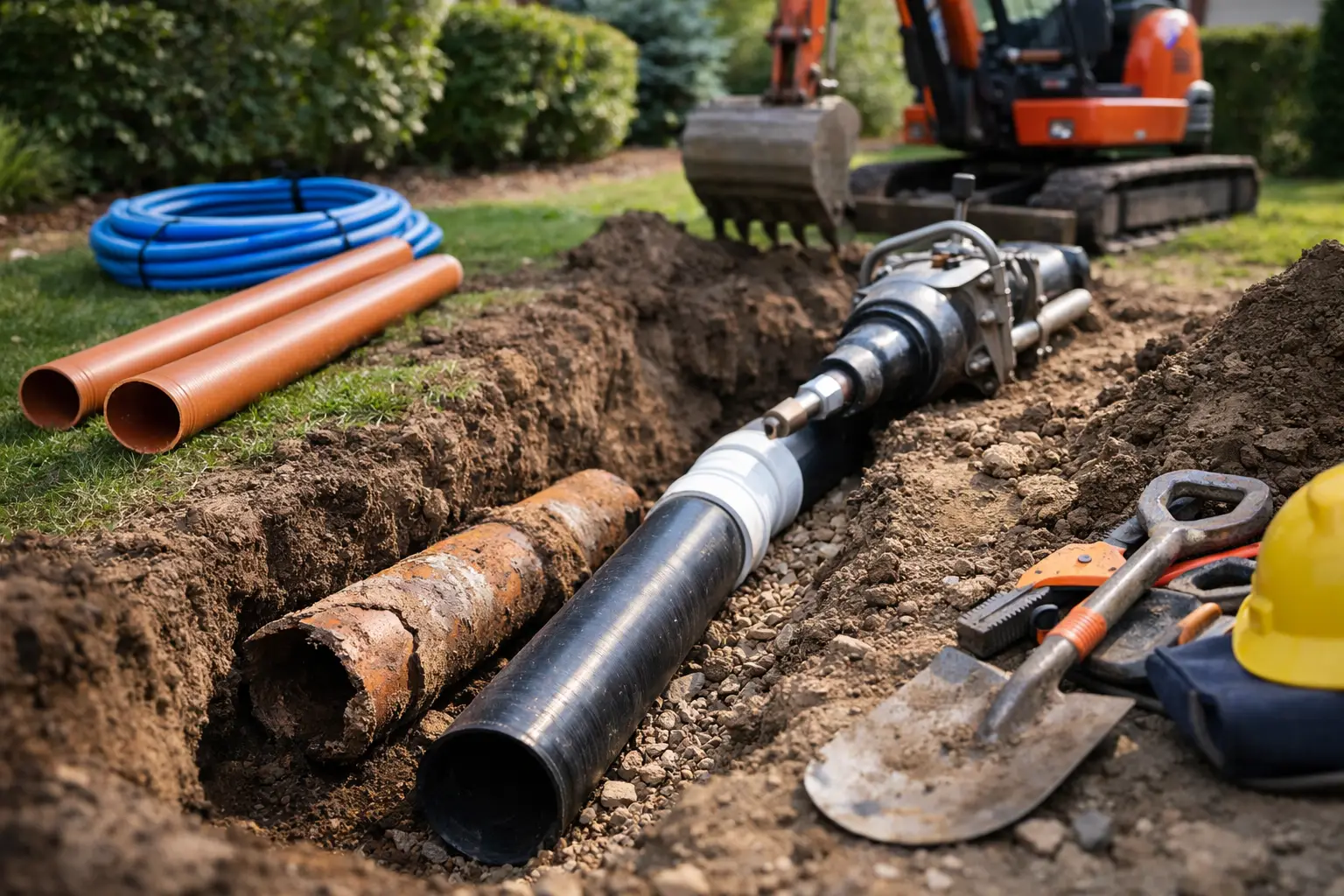
Traditional sewer replacement involves digging a trench to expose the damaged line, removing the old pipe, and installing a new one. This is the method most people picture when they think about sewer work, and in some situations, it is still the right choice.
If the pipe has severe collapse, major offset sections, multiple belly areas, or conditions that prevent trenchless access, excavation may be necessary. It can also make sense when other underground utilities must be reconfigured or when the line needs a major reroute.
The trade-off is disruption. Excavation often means removing landscaping, cutting concrete or asphalt, disturbing fencing, affecting driveways, and creating a larger work zone. On commercial and municipal sites, that can also mean access restrictions, operational delays, and more surface restoration after the pipe work is complete.
Trenchless pipe bursting
Pipe bursting is a trenchless replacement method that breaks apart the old pipe while simultaneously pulling a new pipe into place. In many cases, this allows a contractor to replace the full line with minimal digging, typically using entry and exit points rather than a continuous trench.
This option is often a strong fit when the existing pipe is too damaged for lining but the path of the sewer line is still workable. It is especially useful for replacing aging clay, Orangeburg, cast iron, or brittle pipes that have reached the end of their service life.
For homeowners, the biggest benefit is less damage to yards, patios, and driveways. For commercial properties, schools, hospitals, restaurants, hotels, and municipal sites, the value is even clearer: less surface disruption, faster completion, and reduced impact on daily operations. Pipe bursting can also allow for upsizing in some cases, which helps when added capacity is needed.
It does require proper access and suitable site conditions. A qualified inspection and project review will confirm whether the line can be burst safely and effectively.
CIPP epoxy pipe lining
Cured-in-place pipe lining, often called CIPP lining, restores an existing pipe from the inside. A resin-saturated liner is inserted into the host pipe, positioned in place, and cured to form a new structural pipe within the old one.
This is not full pipe replacement in the traditional sense, but it is one of the most effective alternatives when the line is structurally restorable. For many owners comparing sewer line replacement options, lining is the best solution because it avoids extensive digging while delivering long-term performance.
CIPP lining works well for pipes with cracks, leaks, joint separation, and root intrusion, as long as the original pipe has not completely failed beyond restoration. It is commonly used in homes, multi-family properties, commercial facilities, industrial buildings, schools, healthcare campuses, and historic properties where preserving the surface is a priority.
The practical advantage is speed and minimal disruption. Instead of trenching across a yard, parking lot, landscaped area, or interior slab, the work is completed through existing access points whenever possible. That means less mess, less labor tied to restoration, and less interruption for occupants or customers.
When trenchless methods make the most sense
Trenchless methods are often the best fit when the surface above the sewer line has real value. If your line runs under decorative concrete, retaining walls, mature trees, roadways, tenant improvements, or high-traffic public areas, avoiding excavation can significantly change the economics of the project.
This matters in Denver-area properties where freeze-thaw conditions, older neighborhoods, and mixed pipe materials often complicate underground work. It also matters on active commercial sites where downtime carries a direct cost. A hospital cannot easily shut down access. A restaurant cannot afford prolonged disruption. A hotel, school, or senior living facility needs work completed with control and precision.
That is where specialized trenchless expertise matters. The equipment, planning, and installation process are different from standard plumbing work. Property owners should look for a contractor that regularly handles underground rehabilitation, not one that treats trenchless service as a side offering.
Cost is not just the pipe work
Many people compare sewer line replacement options by focusing only on the base repair price. That is understandable, but it does not give a complete picture.
A traditional excavation may appear less expensive at first. But if the project requires concrete demolition, landscape restoration, hardscape replacement, traffic management, interior demolition, or lost operational time, the final cost can rise quickly. By contrast, trenchless methods often reduce those secondary expenses because they limit how much of the site must be disturbed.
That does not mean trenchless is always cheaper. Some lines are poor candidates for lining. Some sites need excavation because of collapse, depth, alignment issues, or access constraints. The point is that the smartest decision comes from total project cost, not just the line item for pipe installation.
How to choose between sewer line replacement options
Start with facts, not guesswork. A professional video inspection should identify the exact condition of the line and whether the problem is isolated, widespread, or structural. From there, the contractor should explain what is possible, what is not, and why.
A trustworthy recommendation will consider the pipe’s condition, the surface impact, how quickly service must be restored, and how the property is used day to day. For a homeowner, protecting a finished yard or driveway may be the top concern. For a property manager, the priority may be tenant continuity. For a municipality or facility leader, project control and public impact often drive the decision.
It is also reasonable to ask how long the solution is expected to last, whether the method addresses root intrusion and joint failure, what preparation is required before installation, and what guarantee backs the work. Experienced sewer specialists should be able to answer those questions clearly.
Why diagnosis comes before replacement
Not every failing sewer line needs a full replacement. Some lines can be cleaned and lined. Others need sectional repairs. Some need complete replacement because deterioration is too advanced. Without a proper inspection, you risk paying for the wrong scope.
That is why specialized contractors put diagnostics first. A camera inspection does more than confirm there is a problem. It defines the method, limits surprises, and helps avoid unnecessary excavation. For a results-driven company like All Sewer and Plumbing Services, LLC, that diagnostic step is what allows the repair plan to match the property instead of forcing the property to fit a standard method.
When you are dealing with sewer failure, speed matters, but accuracy matters more. The right replacement approach is the one that restores the line reliably while causing the least practical disruption to your home, business, or facility. If you start with a clear inspection and a contractor who knows both trenchless and conventional methods, you can make that choice with confidence instead of urgency alone.
A sewer line is buried infrastructure, but the decision about how to replace it shows up everywhere above ground – in your schedule, your budget, and how much of your property stays intact when the work is done.
FREE Estimates
How can we help you?

our services


contact our team today
Contact a service professional at All Sewer and Plumbing Services LLC today. We are here to answer all your questions.
OPEN 24 hours 7 days a week