Cost of Trenchless Sewer Replacement: 2026 Guide
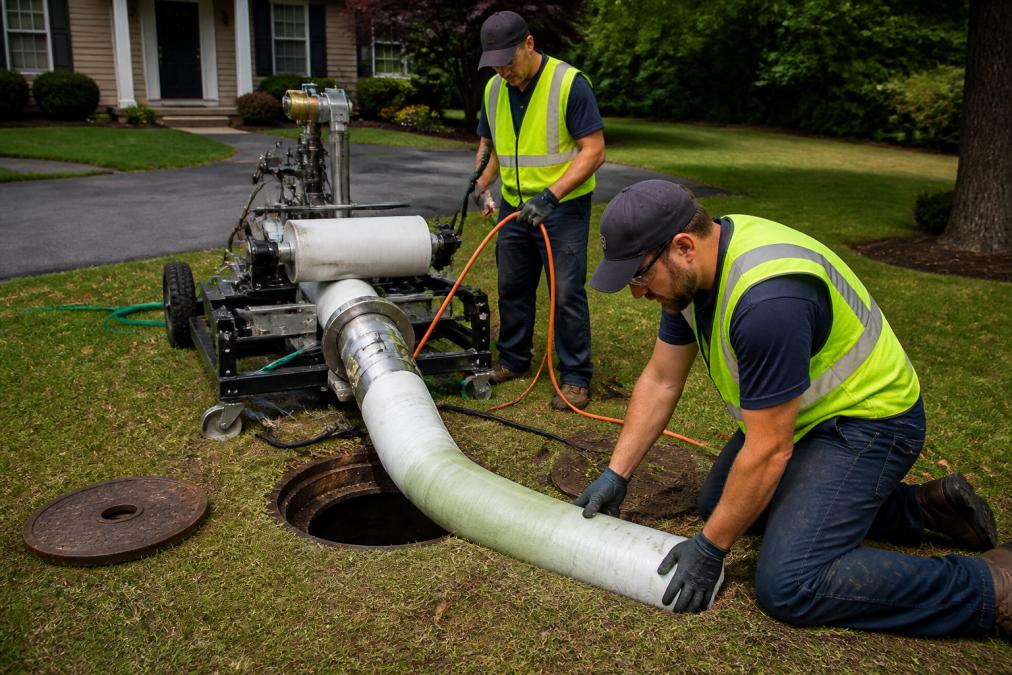
Table of Contents
- What Drives the Cost of Trenchless Sewer Replacement
- Pipe Bursting vs. CIPP Lining: Methods and Cost Differences
- Trenchless Sewer Repair vs Traditional Excavation Cost
- When Trenchless Repair Is Not Possible
- How Long Does Trenchless Sewer Repair Last
- Is Trenchless Sewer Repair Covered by Insurance
- Post-Repair Inspection Standards and What to Expect
- Conclusion
Last Updated: August 24, 2026
Replacing a failing sewer line is one of the most stressful repairs a property owner can face. At All Sewer and Plumbing Services, LLC, we’ve walked homeowners and commercial property managers through this decision. Pricing varies significantly based on factors most contractors never explain upfront. Below, we’ll break down exactly what drives those numbers, how the two main trenchless methods compare, and where the financial comparison with traditional excavation gets interesting.
Trenchless sewer replacement is a method of rehabilitating or replacing a damaged underground sewer line with minimal surface excavation, using specialized equipment inserted through small access pits rather than an open trench. According to the Environmental Protection Agency’s guide on infrastructure rehabilitation, trenchless technologies have become a preferred method for municipal and residential underground pipe repair because they reduce surface disruption and can extend pipe service life significantly.
What Drives the Cost of Trenchless Sewer Replacement
The cost of trenchless sewer replacement is not a fixed number. Any contractor who quotes you a price without first running a video camera inspection should raise a red flag.
Pipe Diameter and Sewer Lateral Length
Pipe diameter and total linear footage are the two most direct cost drivers. A standard residential sewer line typically runs 4 to 6 inches in diameter, while commercial mains can run 8 inches or wider. Larger diameter pipe requires more resin for CIPP lining or heavier-duty bursting heads, increasing material and equipment costs. A short run from a house cleanout to the city main might be 30 feet; an older home on a deep lot might have 100 feet or more. Per-foot pricing is standard, so longer runs cost more, though longer jobs sometimes carry a lower per-foot rate because mobilization costs spread across more footage.
Soil Conditions and Excavation Depth
Soil and geological conditions can shift a project estimate substantially. Clay soils common in older neighborhoods hold their shape well and create predictable working conditions. Rocky substrates or unstable sandy soils complicate access pit excavation and can slow the pipe bursting process.
Depth is equally critical. A sewer line buried 4 feet down is straightforward to access. Lines buried 8 to 12 feet, common in colder climates, require deeper access pits, more labor time, and sometimes shoring equipment to maintain a safe working environment.
Permits, Inspections, and Equipment Mobilization
Permits are a non-negotiable cost on any sewer line project and vary by municipality. Most jurisdictions require a permit before work begins and a post-repair inspection by a licensed inspector. Equipment mobilization is another line item that often surprises property owners. Pipe bursting and CIPP lining both require specialized equipment that must be transported, set up, and calibrated on site. For short jobs, mobilization can represent a meaningful percentage of the total cost.
| Cost Factor | Low Impact | High Impact |
|---|---|---|
| Pipe length | Under 40 linear feet | Over 80 linear feet |
| Pipe diameter | 4-inch residential | 8-inch or larger |
| Soil conditions | Stable clay or loam | Rock, sand, or unstable fill |
| Depth | Under 5 feet | Over 8 feet |
| Permits and inspections | Simple residential permit | Multiple inspections required |
| Equipment mobilization | Local, short setup | Long distance, complex rig |
Pipe Bursting vs. CIPP Lining: Methods and Cost Differences
Two distinct technologies dominate the trenchless sewer repair market. The condition of your existing pipe determines which method is viable.
How Pipe Bursting Works
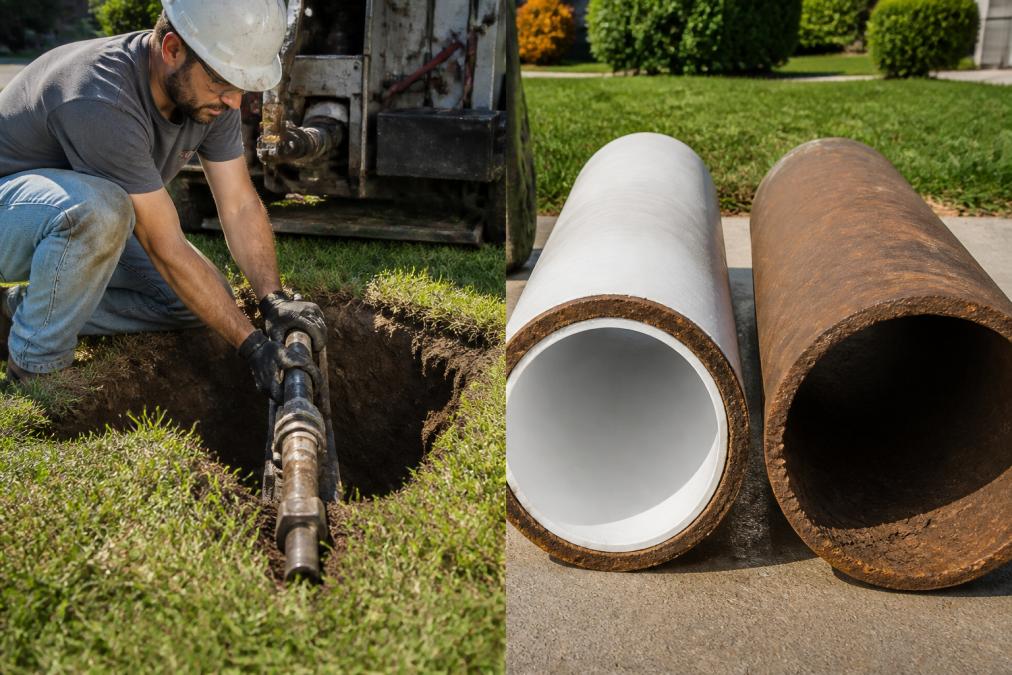
Pipe bursting is a trenchless replacement method where a bursting head is pulled through the existing damaged pipe, fracturing it outward into the surrounding soil while simultaneously pulling a new pipe into place behind it. The result is a completely new pipe, typically high-density polyethylene (HDPE), installed in the same path as the old one.
This method works well when the existing pipe has collapsed sections, severe root intrusion, or structural failure that makes lining impractical. Because you’re installing a new pipe rather than coating an old one, pipe bursting restores full pipe diameter and structural integrity. Two small access pits at each end of the run are all the excavation required.
Pipe bursting is generally the more expensive of the two trenchless methods because it involves new pipe material for the entire run, a more mechanically demanding process, and typically longer setup time. It’s also not viable in very rocky ground, which can prevent the bursting head from effectively fracturing the old pipe.
How Cured-in-Place Pipe (CIPP) Lining Works
Cured-in-place pipe (CIPP) lining is a trenchless repair method where a flexible liner saturated with epoxy resin is inserted into the existing damaged pipe, inflated to press against the pipe walls, and then cured to form a rigid, jointless pipe within the original pipe.
CIPP lining is the right choice when the existing pipe retains enough structural integrity to serve as a mold. It’s highly effective for pipes with cracks, minor corrosion, root intrusion, and joint failures. Most residential CIPP lining jobs are complete and ready for use within hours of the liner being installed.
Because CIPP uses the existing pipe as its host, it slightly reduces the internal pipe diameter, typically by a few millimeters. For most residential sewer laterals, this reduction has no practical effect on flow capacity. All Sewer and Plumbing Services, LLC has used CIPP epoxy pipe lining for over two decades, including on original clay pipes in homes dating to the early 1900s.
Before any trenchless repair begins, a video camera inspection (sewer scope) is essential. It identifies the location, type, and severity of damage, confirms whether the pipe has sufficient structural integrity for CIPP lining, and establishes a baseline for the post-repair inspection. Never skip this step.
Trenchless Sewer Repair vs Traditional Excavation Cost
The trenchless sewer repair vs traditional excavation cost comparison is more nuanced than most contractors present it.
Upfront Price vs. Total Project Cost
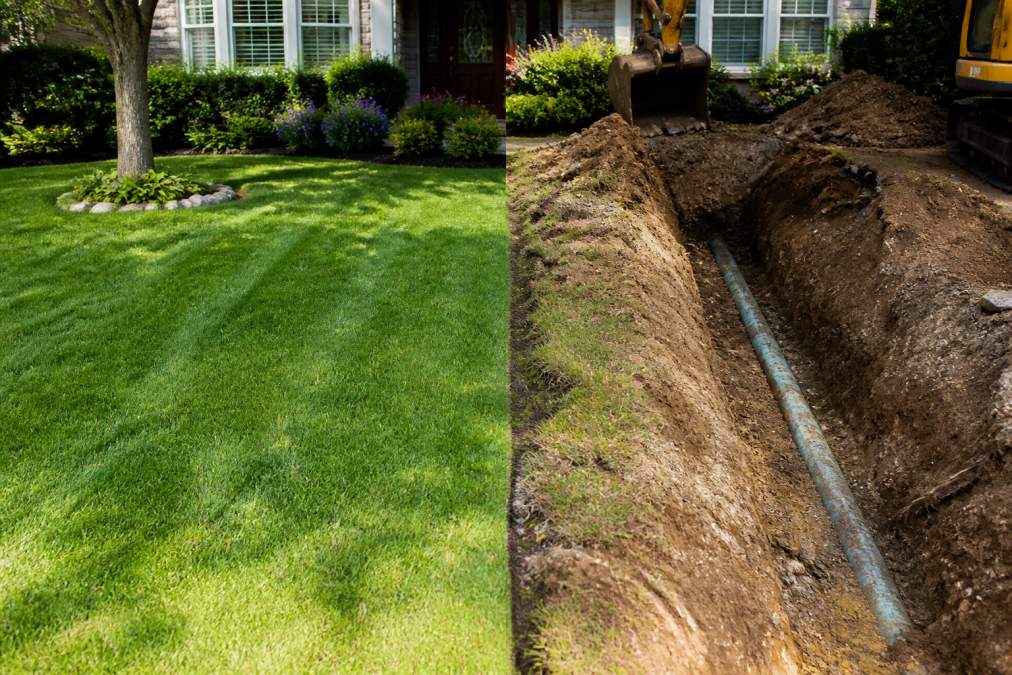
Trenchless repair typically carries a higher upfront labor and equipment cost than traditional trenching for the pipe work itself. However, that figure excludes the costs that come after the pipe work is done. Traditional excavation requires a crew to trench the entire length of the sewer line, remove the old pipe, install new pipe, backfill the trench, and compact the soil. The per-foot pipe replacement cost may appear lower on paper, but this excludes restoration costs.
Landscaping Restoration and Hidden Costs of Trenching
Landscaping restoration is the line item that traditional excavation quotes almost never include upfront. A trench through a front yard destroys sod, disrupts irrigation systems, damages tree roots, and can crack concrete driveways or walkways. Restoring a yard to its pre-repair condition can add thousands of dollars to the total project cost.
According to the American Society of Civil Engineers’ infrastructure report, buried infrastructure repair costs consistently exceed initial estimates when surface restoration is factored in. Trenchless methods sidestep most of that entirely. With pipe bursting or CIPP lining, the only excavation is the access pit, typically 2 to 4 square feet of surface disturbance per entry point. For commercial properties where business interruption is a real cost, trenchless repair’s speed advantage compounds the financial case further. Most trenchless repairs on residential sewer lines are complete within a day, while traditional excavation might take several days.
| Factor | Trenchless Repair | Traditional Excavation |
|---|---|---|
| Surface disruption | Minimal (access pits only) | Full trench length |
| Landscaping restoration | Rarely needed | Often required |
| Project duration | Hours to 1 day | 1 to several days |
| Business interruption risk | Low | Moderate to high |
| Upfront labor cost | Higher | Lower |
| Total project cost | Often comparable or lower | Often higher when restoration included |
When Trenchless Repair Is Not Possible
Trenchless technology is not a universal solution, and an honest contractor will tell you when it isn’t the right fit.
Pipe bursting becomes problematic when the existing pipe runs through very dense rock that the bursting head cannot displace, or when the pipe path runs too close to other underground utilities that could be damaged by the outward fracturing force. Severe offset joints, where two pipe sections have shifted significantly out of alignment, can prevent liner insertion or bursting equipment from passing through. A thorough sewer scope prior to any work will identify these conditions before the project begins.
Be cautious of any contractor who recommends trenchless repair without first performing a (/services/video-sewer-inspection/). Skipping the sewer scope to save time or money upfront is the single most common cause of failed trenchless repairs, and the cost of redoing the work falls on you.
How Long Does Trenchless Sewer Repair Last
Trenchless sewer repair, when properly installed, is a long-term structural solution. CIPP liners installed with quality epoxy resin are rated by manufacturers for 50 years or more of service life under normal operating conditions. Pipe bursting installs new HDPE pipe, which carries comparable longevity expectations.
The key qualifier is "properly installed." Curing time, resin mix ratios, liner inversion pressure, and post-installation inspection all affect the final result. According to the Water Research Foundation’s trenchless technology guidance, CIPP installations have demonstrated decades of reliable service in municipal and residential applications when installation standards are followed. Hydro-jetting the line before lining is also standard practice, removing grease, debris, and loose root material that would otherwise compromise adhesion.
Is Trenchless Sewer Repair Covered by Insurance
This is one of the most common questions homeowners ask, and the answer requires understanding what standard homeowners policies actually cover versus what they exclude.
What Standard Homeowners Policies Typically Cover
Standard homeowners insurance policies generally cover sudden and accidental damage to your sewer system, for example, if a tree falls and crushes your sewer lateral, or if a sudden pipe burst causes immediate damage. What they typically do not cover is gradual deterioration, root intrusion that developed over years, corrosion, or collapse from age. Most sewer line failures fall into the latter category.
The sewer lateral, the pipe that runs from your home to the municipal main line, is the homeowner’s responsibility in most jurisdictions. The city or utility district owns and maintains the main line; you own everything on your side of the connection point.
Service Line Coverage Add-Ons Worth Reviewing
Service line coverage is a relatively recent add-on endorsement offered by many insurance carriers that specifically covers the underground pipes connecting your home to public utilities. This coverage is worth reviewing carefully if you own an older home with original clay or cast iron sewer laterals.
Service line endorsements typically cover repair or replacement costs for the sewer lateral, water service line, and sometimes electrical conduit. Many carriers will cover trenchless sewer replacement under a valid service line claim, but confirm this with your carrier before assuming. Document everything before work begins. A pre-repair sewer scope video, the contractor’s written assessment, and photographs of any visible damage create the paper trail an insurance adjuster needs to process a claim efficiently.
Post-Repair Inspection Standards and What to Expect
Post-repair inspection is the step that separates a completed trenchless sewer job from a verified one. After CIPP lining or pipe bursting, a video camera inspection of the finished pipe is the industry standard for confirming the repair meets quality expectations.
For CIPP lining, the post-repair camera inspection checks for wrinkles, voids, or areas where the liner didn’t fully adhere to the host pipe. It confirms the liner ran the full intended length, that end terminations are properly seated at the cleanout and connection points, and that no lateral connections were inadvertently blocked during installation.
For pipe bursting, the inspection confirms the new pipe is seated correctly, joints are intact, and no soil intrusion occurred during installation. According to NASSCO’s pipeline assessment and certification standards, standardized post-installation inspection protocols exist specifically to ensure trenchless repairs meet defined quality thresholds. Reputable contractors follow these standards and provide the inspection video to the property owner as part of project closeout documentation.
A trenchless sewer repair is only as reliable as its post-installation inspection. The camera video is your quality assurance document; request it as a standard deliverable, not an optional extra.
Sewer line failure doesn’t improve with time, and the longer a damaged lateral goes unaddressed, the more likely a minor lining candidate becomes a full pipe bursting project or, worse, a traditional excavation job. All Sewer and Plumbing Services, LLC has specialized in CIPP epoxy pipe lining and pipe bursting since 2009, serving residential, commercial, and municipal clients with minimal excavation and maximum precision. We offer free estimates so you know exactly what you’re dealing with before committing to any work. Schedule now and get a clear, honest assessment of your sewer system from a team that has seen, and solved, virtually every underground infrastructure scenario there is.
Frequently Asked Questions
Q: Is trenchless sewer repair more expensive than traditional excavation?
A: The per-foot labor cost for trenchless sewer replacement is often higher than traditional trenching. However, traditional excavation adds significant costs for concrete breaking, landscaping restoration, driveway repair, and longer labor time. When you account for those restoration expenses, trenchless repair frequently comes out equal to or less than the total bill for conventional excavation. Request an itemized estimate that includes restoration costs before comparing quotes.
Q: How does pipe bursting differ from CIPP lining in terms of cost?
A: Pipe bursting replaces the existing sewer line entirely by fracturing it outward while pulling a new pipe through. CIPP lining installs a resin-saturated liner inside the existing pipe, which cures in place to form a new interior surface. Pipe bursting generally costs more because it requires a new host pipe and more equipment mobilization. CIPP lining can be less expensive when the existing pipe still has adequate structural integrity to support the liner.
Q: Does homeowners insurance cover sewer line replacement?
A: Standard homeowners insurance policies typically exclude sewer line repairs because the sewer lateral is considered a maintenance item. Coverage may apply if sudden, accidental damage caused the failure, such as a tree falling on the line. Many insurers offer a separate service line endorsement that covers underground pipe repair. Review your policy declarations page carefully and ask your insurer specifically about sewer lateral coverage before assuming the cost of trenchless sewer replacement will be reimbursed.
Q: What is the typical lifespan of trenchless pipe lining?
A: Cured-in-place pipe (CIPP) liners are generally rated to last 50 years under normal residential sewer conditions. Pipe bursting installs a new high-density polyethylene pipe with a comparable service life. Both methods significantly outlast short-term fixes like hydro-jetting alone. The actual lifespan depends on soil conditions, pipe diameter, flow volume, and whether root intrusion is fully addressed before the liner or new pipe is installed.
Q: What are the disadvantages of trenchless sewer line replacement?
A: Trenchless repair is not suitable for every situation. Severely collapsed pipes, pipes with major offset joints, or lines with significant bellying may require traditional excavation first. The upfront per-foot cost is higher than basic trenching labor. Access pits are still needed at each end of the repair section, so some digging is unavoidable. A video camera inspection before any work begins is the only reliable way to confirm whether your sewer line qualifies for a trenchless approach.
Q: How long does the trenchless sewer repair process take?
A: Most residential trenchless sewer repairs complete in one to two days. CIPP lining requires curing time after the resin is installed, which can add several hours depending on the method used (steam, UV light, or ambient cure). Pipe bursting is typically faster once equipment is mobilized. Complex commercial or municipal projects with longer sewer laterals or multiple access points may take several days. Your contractor should provide a timeline estimate after the video camera inspection.
This article was written using GrandRanker
FREE Estimates
How can we help you?

our services


contact our team today
Contact a service professional at All Sewer and Plumbing Services LLC today. We are here to answer all your questions.
OPEN 24 hours 7 days a week