Trenchless Sewer Repair for Clay Pipes: A Complete Guide

Table of Contents
- What Is Trenchless Sewer Repair for Clay Pipes?
- Signs of Clay Pipe Failure You Shouldn’t Ignore
- Pipe Bursting vs. CIPP Lining: Which Method Works Best for Clay?
- How Long Does Trenchless Sewer Repair Take?
- The Video Camera Inspection: Understanding What’s Really Wrong
- Durability and Long-Term Performance of Trenchless Repairs
- Getting Your Free Estimate and Moving Forward
- Frequently Asked Questions
Last Updated: September 3, 2026
What Is Trenchless Sewer Repair for Clay Pipes?
Trenchless sewer repair for clay pipes is a method of restoring damaged underground sewer lines without excavating your yard, driveway, or landscape. At All Sewer and Plumbing Services, LLC, we use advanced technologies like cured-in-place pipe (CIPP) lining and pipe bursting to rehabilitate aging clay sewer systems from the inside out. Instead of tearing up your property, we access the damaged pipe through existing access points and either reinforce it with epoxy-impregnated liners or replace it by fracturing the old pipe and pulling new pipe through the space it occupied.
Clay pipes have been the standard for residential sewer lines for over a century. They’re durable when conditions are stable, but they’re vulnerable to specific failure modes: root intrusion through offset joints, soil settlement that cracks the pipe, and mineral deposits that restrict flow. Traditional excavation repair means removing trees, breaking concrete, and disrupting your landscape for weeks. Trenchless technology eliminates that disruption entirely.
The core advantage is preservation. Your property stays intact. Your business stays open. Your tenants stay connected to water and sewer service. The repair happens below ground, where the problem actually is.
Signs of Clay Pipe Failure You Shouldn’t Ignore
Clay pipes fail in predictable ways, and catching them early saves money and prevents emergency backups. The most common warning signs are slow drains that worsen over time, raw sewage backing up into lowest-level fixtures (basement drains, lowest toilets), and soggy patches in your yard even when it hasn’t rained.
Root intrusion is the leading cause of clay pipe failure (peer-reviewed research). Tree roots seek moisture and nutrients. They find microscopic cracks in clay joints and exploit them, growing inside the pipe until they create a blockage. You’ll notice slow drainage in multiple fixtures simultaneously, not just one. Snaking the line provides temporary relief, water flows again for a few weeks or months, but the roots return because the underlying crack remains.
Offset joints are another clay-specific vulnerability. Clay pipes connect via bell-and-spigot joints that rely on gravity and soil support to stay aligned. Ground settlement, freeze-thaw cycles, and heavy vehicle traffic above can shift these joints, creating gaps where roots enter and soil washes into the pipe. A video camera inspection reveals these offsets clearly.
Structural cracks in clay develop from soil movement, age, and corrosion from acidic groundwater. Unlike root intrusion, which is localized, cracks can span several feet of pipe. Water leaks out, soil erodes underneath, and the pipe collapses. Sewage backs up. Sinkholes form.
If your home was built before 1980 and you’ve had the sewer line snaked more than twice in five years, clay pipe failure is likely. Professional video inspection is the only way to confirm what’s actually wrong.
Pipe Bursting vs. CIPP Lining: Which Method Works Best for Clay?
Both trenchless technologies solve clay pipe problems, but they work differently and suit different situations. Understanding the distinction helps you make the right choice for your specific failure.
How Pipe Bursting Restores Clay Sewer Lines
Pipe bursting fractures the old clay pipe in place and pulls new HDPE (high-density polyethylene) pipe through the space it occupied. A bursting head, a hardened steel tool, is pushed or pulled through the damaged pipe, shattering the clay into fragments. Simultaneously, new pipe is fed behind the bursting head, replacing the old line in a single pass.
Pipe bursting works best when the clay pipe has collapsed, severe cracks, or root intrusion too extensive for lining to seal. It’s also the choice when the old pipe’s diameter is too small for your needs, the new pipe can be the same size or slightly larger, improving flow capacity.
The process requires two access points: one where the bursting head enters and one where it exits. For a 50-foot lateral line, that means two excavation pits, each roughly 4 feet by 4 feet. The work takes one to two days depending on soil conditions and pipe length. Clay fractures cleanly, which is an advantage, the bursting head doesn’t have to work as hard as it does in concrete or cast iron.
The main limitation is depth. Bursting works reliably to about 15 feet below grade. Deeper than that, soil pressure becomes problematic. For clay pipes in basements or deep laterals, CIPP lining is often the better choice.
How CIPP Epoxy Lining Works on Clay Pipes
CIPP (cured-in-place pipe) lining coats the interior of the damaged pipe with a flexible, epoxy-impregnated fabric tube. The tube is inverted into the pipe (either by water pressure or air inversion), pressed against the clay walls, and then cured with hot water or UV light. The result is a new structural pipe inside the old one, sealing cracks, blocking root entry points, and restoring flow without removing the clay.
CIPP excels at sealing distributed damage: multiple small cracks, root intrusion along the entire length, and offset joints. Because it’s applied from inside, it requires only one access point, usually a cleanout or the main stack. No second excavation pit means less disruption.
The epoxy liner is typically 3-4 millimeters thick (astm.org). It bonds chemically to the clay surface, creating a monolithic seal that roots cannot penetrate. Unlike snaking, which temporarily clears blockages, CIPP eliminates the cause: the cracks and gaps that allowed roots to enter in the first place.
CIPP works at any depth and in any soil condition because it doesn’t rely on external force. The inversion process is gentle on surrounding utilities and landscape. For clay pipes with distributed damage, CIPP is often faster and less expensive than bursting.
The trade-off is internal diameter. The liner reduces the pipe’s internal diameter by about 6-8 millimeters. For most residential lines, this is negligible. For commercial properties with high flow demands, it may be a consideration.
| Repair Method | Best For | Access Points | Depth Limit | Timeline |
|---|---|---|---|---|
| Pipe Bursting | Collapsed pipes, severe cracks, diameter increase needed | 2 excavation pits | ~15 feet | 1-2 days |
| CIPP Lining | Distributed cracks, root intrusion, offset joints | 1 access point | No limit | 1 day |
How Long Does Trenchless Sewer Repair Take?
The timeline for trenchless sewer repair depends on the method, pipe length, and site conditions. Most homeowners and property managers want to know: how long until my sewer works normally again?
For CIPP lining, the process typically takes 6-12 hours from start to finish. The crew arrives, sets up equipment at the access point, inserts the inverted tube, applies water or UV curing, and leaves. The epoxy cures fully within 24 hours, but water and sewage can flow safely through the new lining immediately after curing is complete. You’re back to normal use the same day.
Pipe bursting takes longer because of the excavation. Digging two access pits takes 4-6 hours depending on soil and obstructions. The bursting itself takes 2-4 hours. Backfilling and site restoration add another 2-3 hours. Total time is typically 8-14 hours spread across one or two days. The new pipe is ready for use immediately after the crew leaves, no curing time required.
For commercial properties and municipal systems, the timeline scales with pipe length. A 100-foot lateral line takes longer than a 50-foot one, but the difference is measured in hours, not days. All Sewer and Plumbing Services, LLC schedules work to minimize business interruption. We often perform repairs during off-hours or coordinate with property managers to stage the work around tenant occupancy.
Weather affects timing. Heavy rain can delay excavation work. Cold temperatures slow epoxy curing. Most trenchless work happens in spring and fall when soil conditions are stable and temperatures are moderate.
The Video Camera Inspection: Understanding What’s Really Wrong
A video camera inspection is the diagnostic foundation for any trenchless repair decision. Before committing to pipe bursting or CIPP lining, we run a waterproof camera through your sewer line to see exactly what’s happening inside.
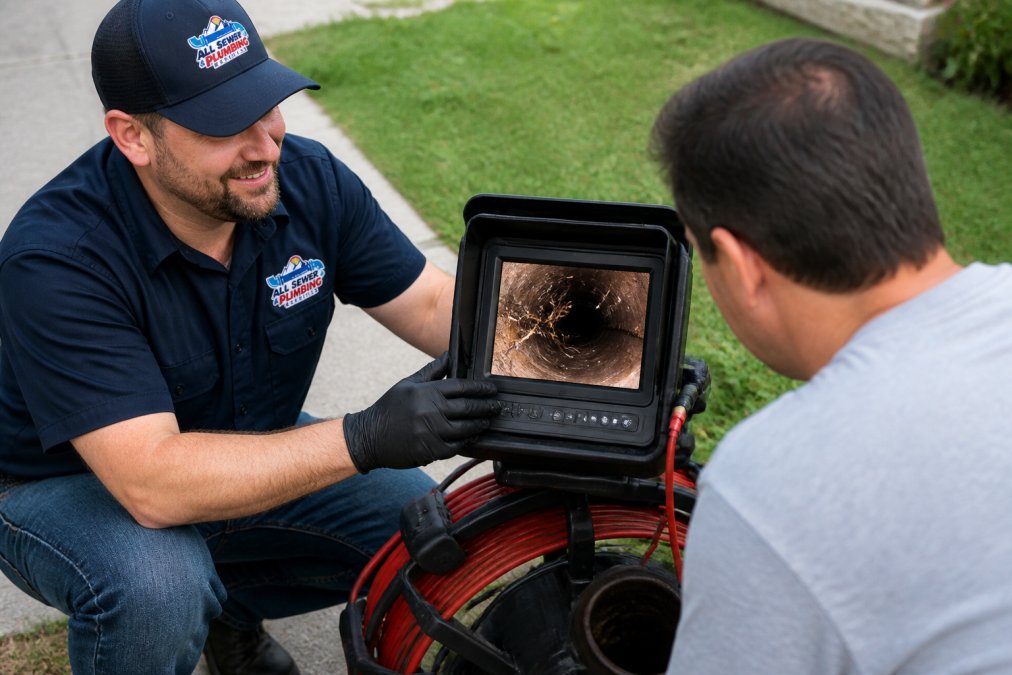
The camera is a small, high-resolution unit attached to a flexible rod. It travels through the pipe, transmitting real-time video to a monitor above ground. The operator can pause, zoom, and document specific defects. The recording becomes part of your repair report.
What does the camera reveal? Root intrusion appears as hair-like fibers protruding into the pipe lumen. Cracks show as dark lines running lengthwise or circumferentially around the pipe. Offset joints appear as steps where two pipe sections no longer align. Mineral deposits look like white or tan buildup on the interior walls. Collapsed sections show as complete blockages.
The camera inspection takes 30-45 minutes for a typical 100-foot lateral line. It’s non-invasive, non-destructive, and provides certainty. Instead of guessing based on symptoms, you see the actual damage. This clarity eliminates surprises during repair. If the inspection reveals a problem worse than expected, say, a complete collapse instead of distributed cracks, you can adjust your repair plan before work begins.
At All Sewer and Plumbing Services, LLC, we provide a detailed report with photos and video clips. You can see what we see. You understand why we recommend a specific repair method. This transparency builds confidence in the solution.
Durability and Long-Term Performance of Trenchless Repairs
How long will trenchless repair actually last? This is the question every homeowner asks, and rightfully so. You’re investing in a solution, not a temporary fix.
CIPP liners are designed for 50+ years of service life (peer-reviewed research). The epoxy material resists root penetration, mineral buildup, and structural stress. It doesn’t corrode like clay or cast iron. It doesn’t develop new cracks because it’s not subject to soil movement the way the original pipe was. Many CIPP installations from the 1980s and 1990s are still performing flawlessly today.
The durability depends on proper installation and curing. If the liner isn’t fully inverted or cured, it can separate from the clay wall and fail prematurely. This is why professional installation matters. All Sewer and Plumbing Services, LLC follows industry standards for inversion speed, curing temperature, and cure time to ensure the liner bonds completely.
Pipe bursting using HDPE pipe offers similar longevity. HDPE is naturally resistant to root intrusion, corrosion, and chemical attack. It’s flexible, so it accommodates minor ground movement without cracking. HDPE sewer pipe is warrantied for 50 years by manufacturers, and field evidence suggests it performs well beyond that.
Post-repair maintenance extends lifespan further. Annual or biennial video inspections catch minor issues before they become problems. Hydro-jetting removes grease and mineral deposits that accumulate over time. Proper grease disposal, never pouring cooking oil down drains, prevents buildup inside the new pipe.
The real advantage over traditional excavation repair is that trenchless solutions restore the pipe to like-new condition. There’s no compromise, no patching. You get a fully functional sewer line that will serve your property for decades.
Getting Your Free Estimate and Moving Forward
The first step is always a video camera inspection and professional assessment. This is how we determine whether trenchless repair is viable for your situation and which method makes sense.
Contact All Sewer and Plumbing Services, LLC to schedule your free estimate. We’ll discuss your symptoms, explain what the camera inspection will reveal, and walk you through repair options. If trenchless repair is appropriate, we’ll outline the timeline, what to expect during the work, and how the solution addresses your specific problem.
Many property owners hesitate because they’ve been burned by temporary fixes, snaking that works for a few months, then the problem returns. Trenchless repair is different. It eliminates the root cause. It restores structural integrity. It’s a permanent solution, not a band-aid.
We also offer services beyond sewer repair. If your property has aging water infrastructure, we can discuss water heater options including tankless water heaters, which provide efficient hot water without the space and maintenance demands of traditional tank models. For property managers and realtors coordinating repairs across multiple properties, we have simplified processes to minimize downtime and keep projects on schedule.
Aging clay sewer pipes don’t have to mean excavation, landscape destruction, and weeks of disruption. Trenchless technology has matured into a reliable, proven solution that restores your sewer system while preserving your property. At All Sewer and Plumbing Services, LLC, we’ve spent over two decades perfecting these techniques for residential, commercial, and municipal clients. Schedule your free camera inspection and estimate today, we’ll show you exactly what’s wrong and exactly how to fix it.
Frequently Asked Questions
Q: Can clay sewer pipes really be relined using trenchless methods, or do I need full excavation?
A: Yes, clay pipes can be successfully relined using trenchless sewer repair methods like CIPP epoxy lining and pipe bursting. CIPP is particularly effective for clay because the epoxy-impregnated liner bonds to the existing pipe wall, restoring structural integrity without removal. Pipe bursting also works well by breaking the old clay pipe and pulling a new HDPE pipe through in one pass. The choice depends on your specific pipe damage, diameter, and soil conditions, a video camera inspection determines which method suits your situation best.
Q: How long does trenchless sewer repair typically take compared to traditional excavation?
A: Trenchless sewer repair usually takes 1-3 days for most residential clay pipe jobs, depending on pipe length and access points. CIPP lining requires time for resin curing, which can take 24-48 hours depending on ambient conditions. Pipe bursting is often faster for shorter runs. Traditional excavation, by contrast, involves digging, pipe removal, and landscape restoration, often taking 5-10 days or longer. The exact timeline depends on factors like pipe diameter, blockages requiring hydro-jetting beforehand, and soil conditions at access points.
Q: What’s the difference between pipe bursting and CIPP lining for clay pipes?
A: Pipe bursting breaks the old clay pipe in place and pulls a new HDPE pipe through simultaneously, replacing the entire pipe. CIPP lining (cured-in-place pipe) inserts an epoxy-impregnated liner into the existing pipe and cures it in place, creating a new pipe wall inside the old one. Pipe bursting is better for completely collapsed pipes or severe offset joints; CIPP works well for structural cracks, root intrusion, and joint leaks. A video camera inspection helps determine which method your clay pipes need.
Q: How long will a trenchless sewer repair last on old clay pipes?
A: Properly installed CIPP epoxy lining typically lasts 40-50 years or longer, often outlasting the original clay pipe. Pipe bursting with HDPE replacement pipes also provides 50+ year durability. Longevity depends on correct installation, proper curing (especially for ambient-cured epoxy), and post-repair maintenance. Clay pipes themselves often fail after 50-75 years due to root intrusion and joint degradation, so trenchless repair extends your sewer system life significantly compared to temporary fixes like snaking.
This article was written using GrandRanker
FREE Estimates
How can we help you?

our services


contact our team today
Contact a service professional at All Sewer and Plumbing Services LLC today. We are here to answer all your questions.
OPEN 24 hours 7 days a week