Pipe Lining vs Pipe Bursting: Which Is Right?
A sewer line failure should not automatically mean tearing through a lawn, driveway, lobby, or parking area. When comparing pipe lining vs pipe bursting, the right answer depends on what the camera inspection finds inside the existing pipe, how badly it has failed, and what needs to happen to its capacity. Both are proven trenchless methods. They solve different problems.
For Denver-area homeowners, property managers, and facility leaders, that distinction can mean the difference between restoring a sewer line through small access points or replacing a collapsed line with a new pipe without a full-length trench. A professional video inspection is the starting point because the condition of the existing line determines which method can deliver a lasting result.
Pipe Lining vs Pipe Bursting: The Core Difference
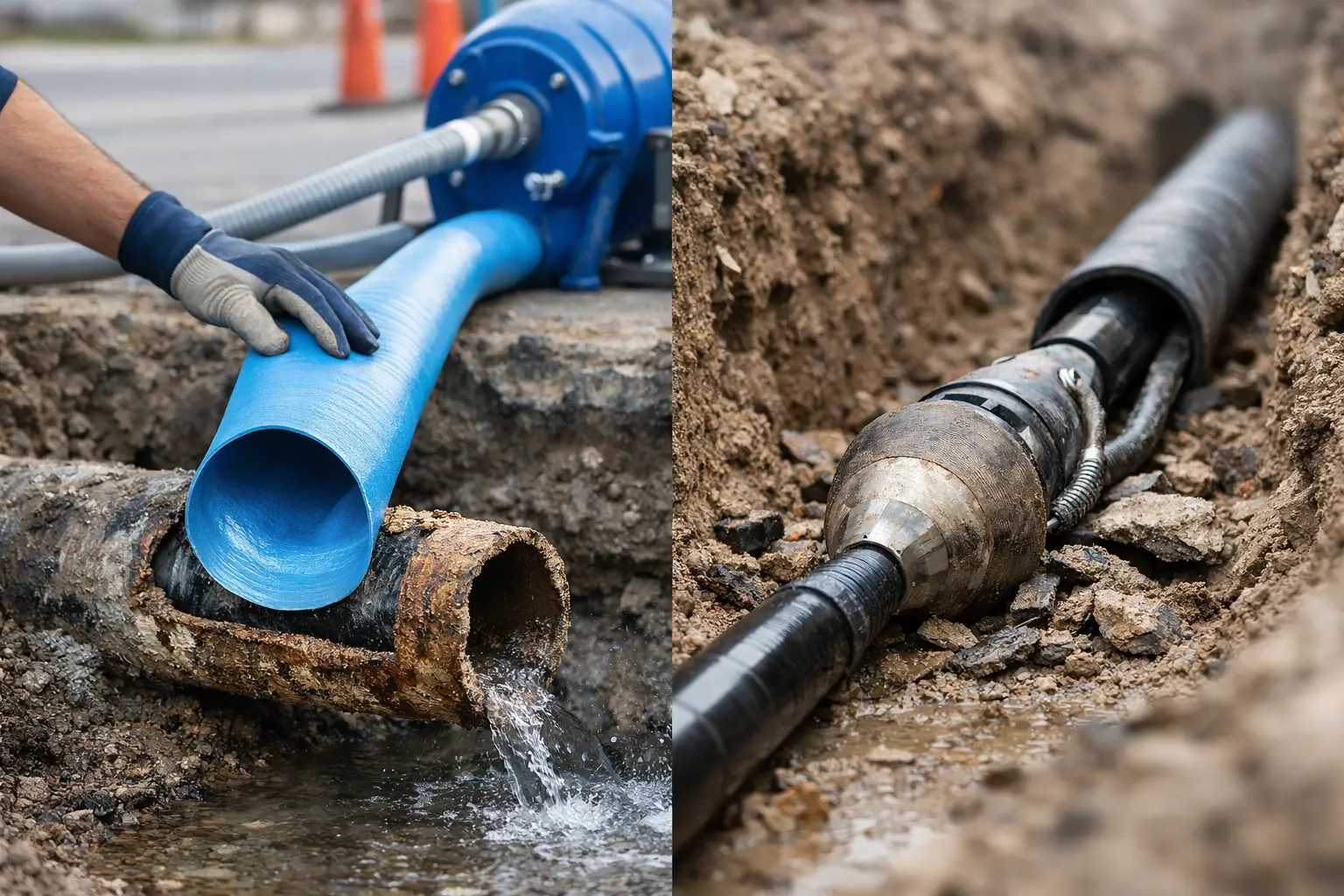
Pipe lining repairs a structurally sound but damaged pipe from the inside. A resin-saturated liner is installed through an existing access point, positioned within the host pipe, and cured into a hard, jointless new pipe. This process is commonly called cured-in-place pipe, or CIPP, lining.
Pipe bursting replaces the old pipe rather than rehabilitating it. A bursting head is pulled through the failed line, breaking apart the old material while pulling a new high-density polyethylene, or HDPE, pipe into place behind it. The replacement pipe is continuous, durable, and resistant to corrosion and root intrusion.
The practical question is simple: Can the existing pipe serve as a stable path for a liner, or has it deteriorated enough that full replacement is the better option? Lining relies on the host pipe’s basic alignment and structure. Bursting is designed for lines that no longer meet that standard.
When Pipe Lining Is the Better Repair
CIPP pipe lining is often the best option for sewer lines with cracks, leaking joints, root intrusion, minor offsets, corrosion, or recurring scale buildup. It is especially useful when the pipe remains generally intact but has defects that allow wastewater to escape or roots to enter.
The liner creates a smooth interior surface that seals cracks and joints. Because the new pipe is formed inside the old one, there is usually little need to disturb finished landscaping, patios, flooring, or other surface features. For a historic building, a landscaped residential property, or a busy commercial site, avoiding excavation can be a major advantage.
Lining can also be an efficient choice when several sections of pipe have similar damage. Rather than excavating at each defect, a qualified crew may rehabilitate a longer section through limited access points. After the liner cures, the line is reopened at branch connections as needed and verified with a camera inspection.
There are limits. Pipe lining slightly reduces the inside diameter of the existing pipe because the liner sits within it. In many residential sewer applications, that reduction does not create a performance issue. However, capacity matters for commercial kitchens, multifamily properties, industrial facilities, and buildings with high wastewater flow. A proper assessment should account for pipe size, slope, use, and future demand rather than treating every damaged line the same.
Lining is also not the answer for every collapsed or severely deformed pipe. If the line has lost its path, contains a major belly, has extensive missing sections, or cannot be adequately cleaned and prepared, forcing a liner into the system may not provide the dependable repair the property needs.
When Pipe Bursting Is the Better Choice
Pipe bursting is typically recommended when a sewer line needs full replacement but conventional excavation would cause excessive damage or disruption. It is effective for old clay, cast iron, Orangeburg, and other failing sewer materials that are cracked, crushed, deteriorated, or repeatedly failing.
Because bursting installs a completely new HDPE pipe, it is often the stronger long-term option when the original line is beyond rehabilitation. HDPE has fused joints, which eliminates the joint openings that commonly attract tree roots in older sewer systems. It also resists corrosion and handles normal ground movement well.
This method can be particularly valuable when a line runs beneath a driveway, mature landscaping, sidewalks, parking areas, or parts of an occupied building. Crews still need entry and exit pits, so trenchless does not mean zero digging. It does mean the property usually avoids a continuous trench from the building to the municipal connection.
Pipe bursting may also allow for an upsized replacement pipe in certain conditions. That can benefit properties where the existing line is undersized for current usage. The feasibility depends on utility clearances, local requirements, soil conditions, the existing pipe route, and the available access. It should never be assumed without reviewing the site.
How Access, Utilities, and Site Conditions Affect the Decision
The pipe itself is only part of the decision. A camera inspection shows internal defects, but a trenchless contractor must also evaluate access points, depth, pipe material, route changes, nearby utilities, and the location of the connection to the main sewer.
Pipe lining generally requires access for cleaning equipment, the liner installation system, and reinstating branch connections. It can be highly efficient when the line can be cleaned thoroughly and the crew can reach the damaged section without opening large areas of the property.
Pipe bursting requires enough room for the pulling equipment and small excavation pits at strategic locations. It may not be appropriate where closely packed underground utilities leave no safe path, where the old pipe route has sharp turns, or where the surrounding conditions make displacement a concern. In those cases, a targeted excavation or a hybrid repair may be more practical.
For commercial and municipal properties, operational requirements matter just as much as construction conditions. A hospital, restaurant, school, hotel, or industrial site may need work scheduled around peak hours, sanitation requirements, traffic flow, or temporary wastewater management. The best repair method is the one that restores the line without creating a larger operational problem.
Cost: Look Beyond the Price of the Pipe Repair
It is reasonable to ask whether pipe lining or pipe bursting costs less. The answer depends on the project. Lining can be cost-effective when it avoids excavation and the existing pipe is a viable host. Bursting can provide better value when lining would only postpone replacement of a severely compromised sewer line.
The visible repair price is not the complete cost. Conventional excavation may require removing and replacing concrete, asphalt, landscaping, irrigation, flooring, fencing, or walls. It can also create downtime for tenants, customers, employees, or residents. Those restoration and disruption costs can exceed the difference between trenchless methods.
A reliable estimate should identify the work scope, access needs, pipe length, pipe diameter, cleaning and preparation requirements, restoration expectations, and any unknown conditions that could affect the project. Low-cost quotes that skip diagnostic work often leave property owners facing change orders after work begins.
Durability and Expected Performance
Both methods can provide long-term sewer solutions when selected and installed correctly. A properly cured epoxy liner forms a corrosion-resistant, jointless pipe within the existing line. A properly installed HDPE replacement pipe provides a new, continuous sewer line with excellent resistance to roots and corrosion.
The deciding factor is not which technology sounds newer or more advanced. It is whether the method matches the failure. Lining is a durable rehabilitation solution for pipes that retain enough structure and alignment. Bursting is a durable replacement solution for pipes that do not.
That is why video inspection, cleaning, and professional evaluation are not optional steps. Root balls, standing water, cracked clay, pipe offsets, and deteriorated Orangeburg can look similar from above ground because they all cause slow drains and backups. The camera reveals whether the line can be restored from within or needs to be replaced.
Get the Right Trenchless Recommendation
A sewer backup is urgent, but the repair decision should be evidence-based. Start with a thorough video sewer inspection and a clear explanation of what the line condition means. Ask whether the pipe can be properly cleaned and lined, whether it has enough structural integrity, whether capacity is a concern, and what surface restoration would be required with each option.
All Sewer and Plumbing Services evaluates the entire project, not just the visible symptom. With the right trenchless method, a failed sewer line can be repaired or replaced while protecting the parts of your property that would be expensive, disruptive, or impossible to rebuild quickly.
The best next step is not choosing pipe lining or pipe bursting from a description alone. It is getting a qualified inspection while the problem is still manageable, before a recurring backup becomes a full sewer failure.
FREE Estimates
How can we help you?

our services


contact our team today
Contact a service professional at All Sewer and Plumbing Services LLC today. We are here to answer all your questions.
OPEN 24 hours 7 days a week