Trenchless Sewer Repair vs Excavation: Cost Comparison

Table of Contents
- Trenchless Sewer Repair vs Excavation: Cost Breakdown
- What Is Trenchless Sewer Repair?
- How Long Does Trenchless Sewer Repair Take?
- Factors Affecting Sewer Repair Costs
- Trenchless Sewer Repair Lifespan and Long-Term Value
- Trenchless vs Traditional Excavation: Pros and Cons
- When to Choose Excavation Over Trenchless Methods
- Frequently Asked Questions
Last Updated: August 29, 2026
Trenchless Sewer Repair vs Excavation: Cost Breakdown
⁵Professional technician inserting flexible CIPP lining equipment into sewer access point with specialized truck-mounted equipment visible in background, morning light
What Is Trenchless Sewer Repair?
Trenchless sewer repair rehabilitates damaged sewer pipes from the inside with minimal or no excavation. Technicians access the damaged pipe through existing clean-outs or small entry points and repair it in place. According to NuFlow Technologies’ trenchless rehabilitation documentation, CIPP lining creates a jointless, corrosion-resistant pipe with a 50+ year design life.
Two primary methods dominate trenchless technology: CIPP pipe lining and pipe bursting.
CIPP Pipe Lining
CIPP (Cured-in-Place Pipe) lining involves inserting a flexible, resin-saturated liner into the damaged pipe. Once positioned, the liner is cured, creating a hard, new pipe inside the old one. This method works best for pipes with cracks, root intrusion, or joint separation. It typically requires only one access point and can rehabilitate pipes 120 feet or longer. Most CIPP jobs complete within a day, with curing times as short as 45 minutes using heat curing. The disadvantage is that CIPP doesn’t address severely collapsed pipes or increase pipe capacity.
Pipe Bursting
Pipe bursting is replacement, not repair. A machine fractures the old pipe while simultaneously pulling a new, larger-diameter pipe into place. This method suits completely failed pipes, severely collapsed sections, or situations requiring increased capacity. According to Vortex Companies’ pipe bursting methodology, the new HDPE pipe carries a 50-year design life. The process requires access pits at both ends but these are significantly smaller than traditional trenches. Pipe bursting typically takes 2-5 days depending on pipe length and soil conditions.
How Long Does Trenchless Sewer Repair Take?
CIPP lining typically completes in one day for residential laterals up to 150 feet, with actual installation taking 4-8 hours and curing adding 45 minutes to several hours. Pipe bursting takes 1-2 days: site preparation and access pit excavation on day, bursting and pipe installation on day one, and cleanup on day two. Municipal projects and complex soil conditions may extend timelines, but even extended trenchless projects complete faster than traditional excavation.
Factors Affecting Sewer Repair Costs
Pipe diameter and length. Smaller diameter pipes (2-4 inches) cost less than larger mains. CIPP pricing typically ranges from $90-$250 per linear foot depending on diameter, accessibility, and regional labor rates.
Accessibility. If the damaged section is under a driveway, patio, or mature landscaping, trenchless methods save thousands in restoration costs. A single concrete driveway restoration can cost $3,000-$8,000 alone.
Pipe material and condition. Clay pipes, cast iron, and older PVC are common candidates for CIPP lining. Severely collapsed pipes may require pipe bursting instead.
Soil conditions. Rocky or clay-heavy soil increases excavation costs. Trenchless methods bypass this challenge, making them more cost-effective in difficult soil.
Permit and inspection fees. Trenchless work often requires fewer permits than excavation, reducing administrative costs.
Business interruption. For commercial properties, the cost of downtime during repair is real. Trenchless methods minimize this risk, making the premium cost worthwhile.
Insurance Coverage: What Homeowners Need to Know
Most standard homeowners insurance policies do not cover sewer line repair or replacement. The sewer line is typically considered the homeowner’s responsibility. However, exceptions exist:
Sudden and accidental damage. If a tree root suddenly breaks through a pipe or a sinkhole opens, some policies cover the damage if deemed “sudden and accidental” rather than wear-and-tear.
Water backup coverage. Some policies include water backup endorsements covering damage caused by sewer backups into your home. This costs $50-$150 annually with limits of $5,000-$25,000.
Sewer line repair endorsements. A growing number of insurers offer optional sewer line repair coverage as a standalone endorsement, covering repair or replacement up to $5,000-$25,000. Premiums range from $75-$200 annually.
What to do: Contact your insurance agent and ask explicitly whether your policy covers sewer line repair and if a sewer line endorsement is available. Request coverage limits and exclusions in writing.
Financing Options That Reduce Out-of-Pocket Cost
Home equity line of credit (HELOC). Typically offers the lowest interest rates (7-9%). You borrow only what you need and pay interest only on the amount drawn.
Personal loan. Unsecured personal loans typically charge 6-12% interest. A $10,000 loan at 9% over 5 years costs roughly $190 monthly.
Contractor financing. Many plumbing contractors partner with financing companies offering 0% interest for 6-12 months or promotional rates. Read the fine print: promotional rates often revert to much higher rates (18-24%) if you miss a payment.
Credit card. If the repair is under $5,000 and you can pay it off within a promotional 0% period, a credit card minimizes cost. Otherwise, standard rates (18-25%) make this expensive.
Municipal payment plans. Some jurisdictions offer low-interest or interest-free payment plans for sewer repairs done through licensed contractors.
Comparison of financing impact on a $12,000 trenchless repair:
|
Financing Method |
Interest Rate |
5-Year Cost |
Monthly Payment |
|---|---|---|---|
|
HELOC |
8% |
$12,960 |
$216 |
|
Personal Loan |
9% |
$13,140 |
$219 |
|
Contractor 0% (12 mo.) |
0% then 18% |
$13,200+ |
$1,000 then $0 |
|
Credit Card (0% promo) |
0% (6 mo.) then 22% |
$12,000-$13,200 |
$2,000 then $0 |
|
Municipal Plan |
2-4% |
$12,600 |
$210 |
True Cost of Ownership: Installation + Financing + Maintenance
Trenchless CIPP lining ($10,000 installed):
- Installation: $10,000
- Financing at 8% over 5 years: +$960
- Maintenance over 50 years: +$12,000-$14,000
- Total 50-year cost: $22,960-$24,960
Excavation and replacement ($12,000 installed):
- Installation: $12,000
- Financing at 8% over 5 years: +$1,152
- Landscape restoration: +$5,000-$8,000
- Second excavation in 30 years (inflation-adjusted): +$20,000
- Maintenance: +$12,000-$14,000
- Total 50-year cost: $50,152-$55,152
Trenchless methods deliver 40-50% lower total cost of ownership over 50 years.
Trenchless Sewer Repair Lifespan and Long-Term Value
CIPP lining carries a design life of 50+ years when properly installed (peer-reviewed research). The epoxy-saturated liner hardens into a durable, jointless pipe that resists root intrusion, corrosion, and ground movement. Pipes lined in the 1980s using early CIPP technology still function without issues. Pipe bursting delivers the same 50-year design life because you’re installing new HDPE pipe.
Long-Term Maintenance and Inspection Requirements
Achieving that 50-year lifespan requires active maintenance. Most municipalities recommend camera inspection of lined pipes every 3-5 years for the first decade after installation, then every 5-10 years thereafter. This inspection costs $300-$800 per inspection and checks for liner separation, cracks, root intrusion, debris accumulation, and joint integrity.
Homeowners should maintain clean-out access points. Regular drain cleaning (every 1-2 years for high-use properties) prevents sediment or grease buildup and costs $150-$400 per cleaning.
Over a 50-year lifespan, inspection and maintenance costs accumulate:
- 10 inspections at $500 average = $5,000
- 25 drain cleanings at $250 average = $6,250
- Potential minor repairs = $1,000-$3,000
Total long-term maintenance cost: $12,000-$14,000 over 50 years
This is significantly lower than the cost of a second excavation and replacement (typically $15,000-$25,000), but it’s a real expense that must be factored into total cost of ownership.
Trenchless vs Traditional Excavation: Pros and Cons
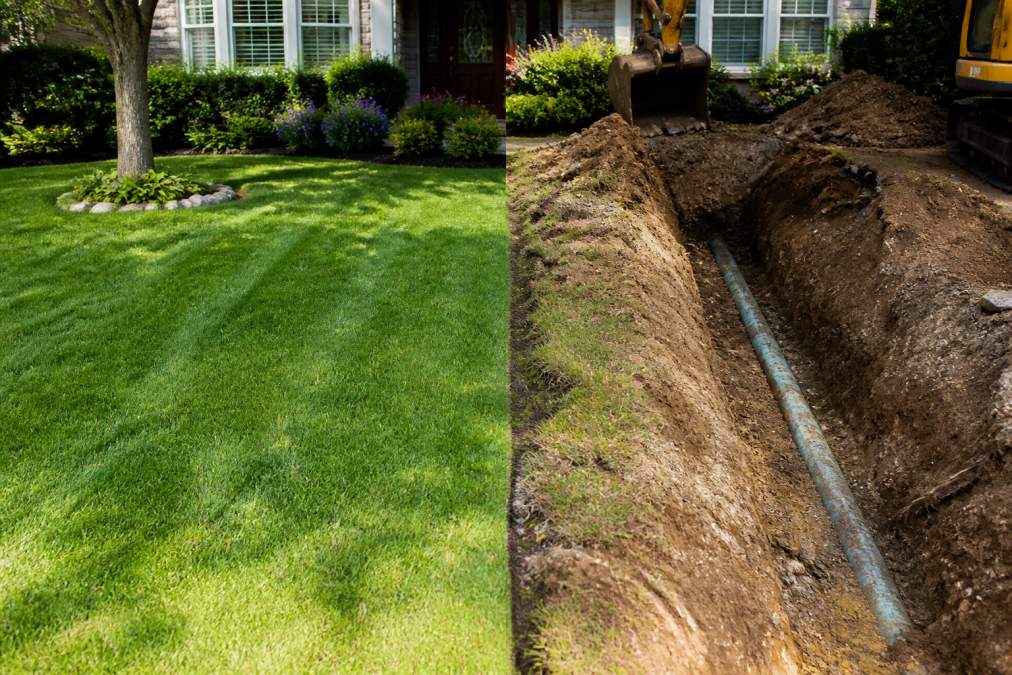
Side-by-side comparison of trenchless sewer repair cost
Trenchless advantages: Minimal property damage preserves yards, driveways, and landscaping. Faster completion times reduce labor costs and business interruption. Trenchless methods work in tighter spaces where excavation equipment can’t fit. The new pipe is stronger and more durable than the original, often with increased corrosion resistance.
Trenchless disadvantages: Higher upfront costs are the primary objection. Not all pipe failures suit trenchless methods; severely collapsed pipes or those with multiple large breaks may require excavation. Access limitations matter, if clean-outs are blocked, trenchless work becomes impossible.
Excavation advantages: Lower upfront cost for simple, accessible repairs on empty lots with no landscaping. Complete replacement allows for pipe upsizing if capacity is an issue. Works on any pipe condition, no matter how severe.
Excavation disadvantages: Extensive property damage disrupts yards, damages driveways, and destroys landscaping. Restoration costs often rival or exceed the repair cost. Longer project timelines mean more labor hours and extended business interruption. Soil disturbance can affect nearby structures and utilities.
When to Choose Excavation Over Trenchless Methods
Despite trenchless technology’s advantages, excavation remains the right choice in specific scenarios.
Severely collapsed or flattened pipes may not accept a liner. If the pipe has collapsed more than 25% of its diameter, CIPP lining can’t form a proper seal.
Multiple large breaks across a section require replacement, not repair. A pipe with three separate breaks across a 100-foot section is a candidate for excavation and full replacement.
Pipe upsizing is essential. If your sewer line is undersized and causing backups, CIPP lining won’t increase capacity. Pipe bursting can upsize, but if bursting isn’t feasible, excavation allows you to install a larger diameter pipe.
Access is impossible. If the damaged section has no accessible clean-outs and the pipe runs under structures preventing access pit placement, trenchless methods won’t work.
Budget constraints are severe. On empty land with no landscaping or hardscape to protect, excavation costs less upfront.
Property is already disrupted. If you’re already excavating for another project, adding sewer repair to the excavation makes economic sense.
When sewer failure strikes, the cost of trenchless sewer repair versus excavation is a choice between protecting your property or accepting significant disruption. All Sewer and Plumbing Services, LLC specializes in trenchless sewer repair using advanced CIPP epoxy pipe lining and pipe bursting technologies, delivering solutions that save time and money while preserving your landscape. Our team provides free estimates and pre-repair camera inspections so you understand exactly what you’re paying for. Schedule now to discuss your sewer repair options with experienced professionals.
Frequently Asked Questions
Is trenchless sewer repair more expensive than traditional excavation?
Trenchless sewer repair costs depend on pipe diameter, length, and soil conditions. While equipment and labor for trenchless methods can appear higher upfront, the total project cost often favors trenchless when you factor in restoration expenses. Traditional excavation requires backfilling, landscaping repair, concrete replacement, and extended property disruption. Request a detailed estimate from a qualified contractor to compare the true all-in cost for your specific situation.
How long does trenchless sewer repair take compared to excavation?
Trenchless sewer repair typically completes in one to three days, depending on pipe length and complexity. CIPP lining can cure in as little as 45 minutes with heat curing or 3 hours with ambient curing. Traditional excavation and pipe replacement often takes one to two weeks or longer, including digging, pipe installation, backfilling, and landscape restoration. The faster timeline with trenchless methods reduces business downtime and property disruption.
How long will a trenchless sewer repair last?
CIPP epoxy pipe lining offers a 50+ year design life, creating a durable, jointless pipe within the existing damaged pipe. The new lining resists root intrusion, corrosion, and leaks. Pipe bursting, which replaces the old pipe with new HDPE material, also provides a 50-year design life. Both methods address the underlying structural failure, not just temporary fixes like hydro-jetting or snaking, which require repeated treatments.
Can trenchless repair work on old clay or cast iron pipes?
Yes. CIPP lining works on clay, cast iron, PVC, and other pipe materials by creating a new pipe inside the damaged one. Pipe bursting also accommodates these materials by fracturing the old pipe and pulling new HDPE pipe into place. A camera inspection of your sewer line determines the exact damage, pipe material, and diameter to confirm which trenchless method is appropriate for your specific situation.
What factors affect the total cost of sewer repair?
Key cost factors include pipe diameter (2 to 12+ inches), repair length, soil type and stability, pipe material, access point availability, permit fees, and equipment mobilization. Property location and site conditions (trees, structures, utilities) also influence pricing. Trenchless methods reduce landscape restoration costs, while excavation requires concrete and landscaping repair. Request a site assessment and detailed estimate that breaks down labor, materials, equipment, permits, and restoration to understand the full financial picture.
This article was written using GrandRanker
FREE Estimates
How can we help you?

our services


contact our team today
Contact a service professional at All Sewer and Plumbing Services LLC today. We are here to answer all your questions.
OPEN 24 hours 7 days a week