Hospital Pipe Lining Without Major Demolition
A sewer backup beneath a hospital is not a routine plumbing call. It can affect patient areas, clinical workflows, sanitation requirements, access routes, and the facility’s ability to stay open. Hospital pipe lining gives facilities leaders a way to restore deteriorating sewer and drain lines from inside the existing pipe, often without opening floors, tearing out walls, or excavating landscaped grounds.
For hospitals, medical campuses, outpatient centers, and long-term care facilities, the value is not simply avoiding a trench. It is controlling risk. A properly planned trenchless repair can shorten the construction window, reduce dust and noise, protect critical building finishes, and keep disruption contained to the smallest practical area.
Why Hospital Sewer Repairs Require a Different Standard
Hospitals operate around the clock. A repair that might be inconvenient at an office building can become a serious operational issue in a healthcare setting. Sewer and drain work may need to be coordinated around patient transport, food service, surgical schedules, isolation procedures, loading docks, and restricted-access spaces.
The underground piping itself may also be difficult to reach. Many healthcare facilities have older cast iron drain lines beneath slabs, below finished corridors, behind equipment rooms, or under additions built over decades. In some cases, a failed lateral runs beneath a parking area, ambulance route, courtyard, or utility corridor where excavation would create a much larger project.
Common warning signs include recurring drain backups, slow fixtures across a wing, sewage odors, repeated root intrusion, water stains, and frequent calls for drain cleaning. Those symptoms do not automatically mean a pipe needs replacement. They do mean the facility needs an accurate diagnosis before a localized failure becomes an emergency.
How Hospital Pipe Lining Works
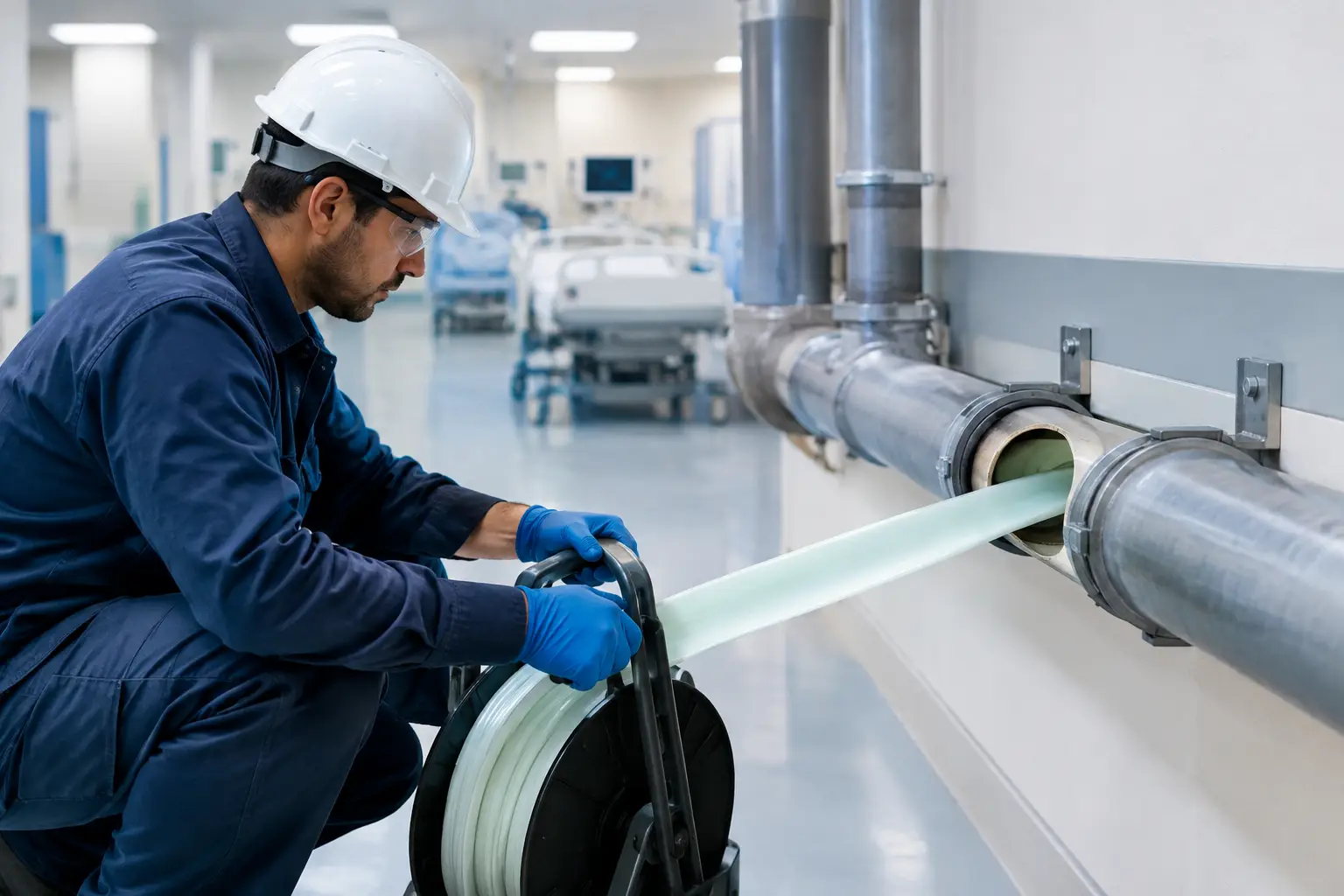
Cured-in-place pipe, commonly called CIPP or epoxy pipe lining, creates a new pipe within the damaged host pipe. After a video sewer inspection identifies the condition and location of the problem, technicians clean the line to remove scale, roots, buildup, and loose debris. A resin-saturated liner is then installed through an existing access point and expanded against the inside wall of the pipe.
Once the liner cures, it forms a continuous, corrosion-resistant pipe inside the old one. The result seals cracks, minor offsets, joint failures, and areas affected by root intrusion without requiring crews to expose the full length of the original pipe.
For a hospital facility, this process can often be performed from a mechanical room, cleanout, exterior access point, or carefully selected work area. The exact approach depends on pipe diameter, line configuration, access, the type of waste being carried, and the building’s operating requirements. A qualified contractor should never treat a healthcare facility like a standard residential lining job.
The Inspection Comes First
Video inspection is the starting point for every dependable trenchless recommendation. It shows whether the line has cracking, channeling, corrosion, breaks, standing water, roots, heavy scaling, or a collapse. It also confirms the pipe’s diameter, route, depth, and connection points.
That information matters because lining is an excellent solution for many damaged pipes, but it is not the right answer for every condition. A line that has fully collapsed, has severe grade problems, or cannot be adequately cleaned may require trenchless pipe bursting or targeted excavation instead. The right repair is the one that restores long-term performance with the least disruption, not the one that happens to sound easiest.
What Pipe Lining Can Help Hospitals Avoid
Traditional sewer replacement can involve saw-cutting concrete, removing flooring, opening walls, relocating equipment, restoring landscaping, and coordinating multiple trades after the plumber leaves. In a healthcare environment, every added trade and work zone can increase scheduling pressure and infection-control planning.
Hospital pipe lining reduces the need for that broad demolition when the existing pipe is structurally suitable for rehabilitation. Fewer access points can mean less noise, less airborne dust, fewer obstructions, and less time spent rebuilding affected spaces. It can also protect expensive surfaces and exterior improvements that would otherwise need to be removed and replaced.
The savings are not limited to excavation costs. Facilities should consider the operational cost of blocked entrances, reduced parking, closed restrooms, disrupted patient flow, overtime coordination, and delayed maintenance work. For many projects, the lowest initial bid is not the lowest total cost once those impacts are counted.
That said, lining does reduce the pipe’s internal diameter slightly. In most properly evaluated applications, the reduction is minimal and does not affect normal drainage. But capacity must be assessed carefully, especially for high-use mains, kitchen waste lines, laundry systems, and other lines with demanding flow conditions.
Planning a Trenchless Repair Around Patient Care
The best hospital sewer projects are planned with facilities staff, not just scheduled around them. Before work begins, the contractor should understand which areas are occupied, which drains serve critical spaces, when traffic is highest, and where equipment and materials can be staged safely.
A practical work plan may include after-hours cleaning, temporary service restrictions, access control, noise limits, clear communication with security and environmental services, and coordination with the facility’s infection-control procedures. Depending on the work location, containment measures and site-specific safety requirements may also be necessary.
Work sequencing is especially important. A drain line should not be taken out of service without confirming what it serves and whether temporary alternatives are available. In older facilities, as-built drawings are not always reliable. Camera inspection and locating equipment provide current field information that helps prevent surprises during the project.
For large campuses, a condition assessment can also help leaders prioritize repairs before a failure occurs. Rather than waiting for the next backup, the facility can identify high-risk lines, document their condition, and schedule rehabilitation during a more manageable maintenance window.
When Pipe Lining Is the Best Option and When It Is Not
Pipe lining is often a strong fit for corroded cast iron, cracked clay, root-damaged sewer laterals, and pipes with leaking joints or moderate deterioration. It is particularly valuable when the line runs beneath a slab, landscaped grounds, a finished lobby, a parking lot, or a building area where demolition would disrupt operations.
It may not be the best option when there is a major collapse, substantial bellies that hold wastewater, extensive missing pipe, or a route that must be changed. In those situations, trenchless pipe bursting can replace the old line with a new pipe along the same path, while excavation may be necessary for a severely compromised section or inaccessible connection.
A dependable recommendation should explain the condition found on camera, the available repair options, the expected project impact, and why one method is better for the facility. Decision-makers should be wary of one-size-fits-all answers. The right method depends on the pipe and the hospital’s operational needs.
Choose a Contractor Built for High-Stakes Infrastructure
Hospital work demands more than basic drain service. The contractor needs proven experience with commercial-scale sewer systems, trained crews, video diagnostic capability, trenchless installation equipment, and disciplined jobsite communication. Insurance, safety practices, scheduling flexibility, and a clear workmanship guarantee should all be part of the conversation.
All Sewer and Plumbing Services, LLC helps Colorado facilities evaluate damaged underground lines and complete trenchless repairs with a focus on speed, workmanship, and minimal property disruption. The goal is to solve the pipe problem without creating a larger facility problem.
When recurring backups or aging drain lines put a healthcare facility at risk, acting early gives the team more choices. A thorough camera inspection and a clear repair plan can turn an urgent concern into a controlled project that protects the building, the staff, and the people who depend on it.
FREE Estimates
How can we help you?

our services


contact our team today
Contact a service professional at All Sewer and Plumbing Services LLC today. We are here to answer all your questions.
OPEN 24 hours 7 days a week